Journal home / All articles / Aftercare and the envelope
A seasonal maintenance calendar for SEQ roofs
South East Queensland does not have four polite seasons. It has a storm season, a leaf-drop argument, a dry stretch that turns dust into grit, and a short window when you can still see what last summer did.
Asha Varghese · 28 July 2025 · Updated 16 August 2026
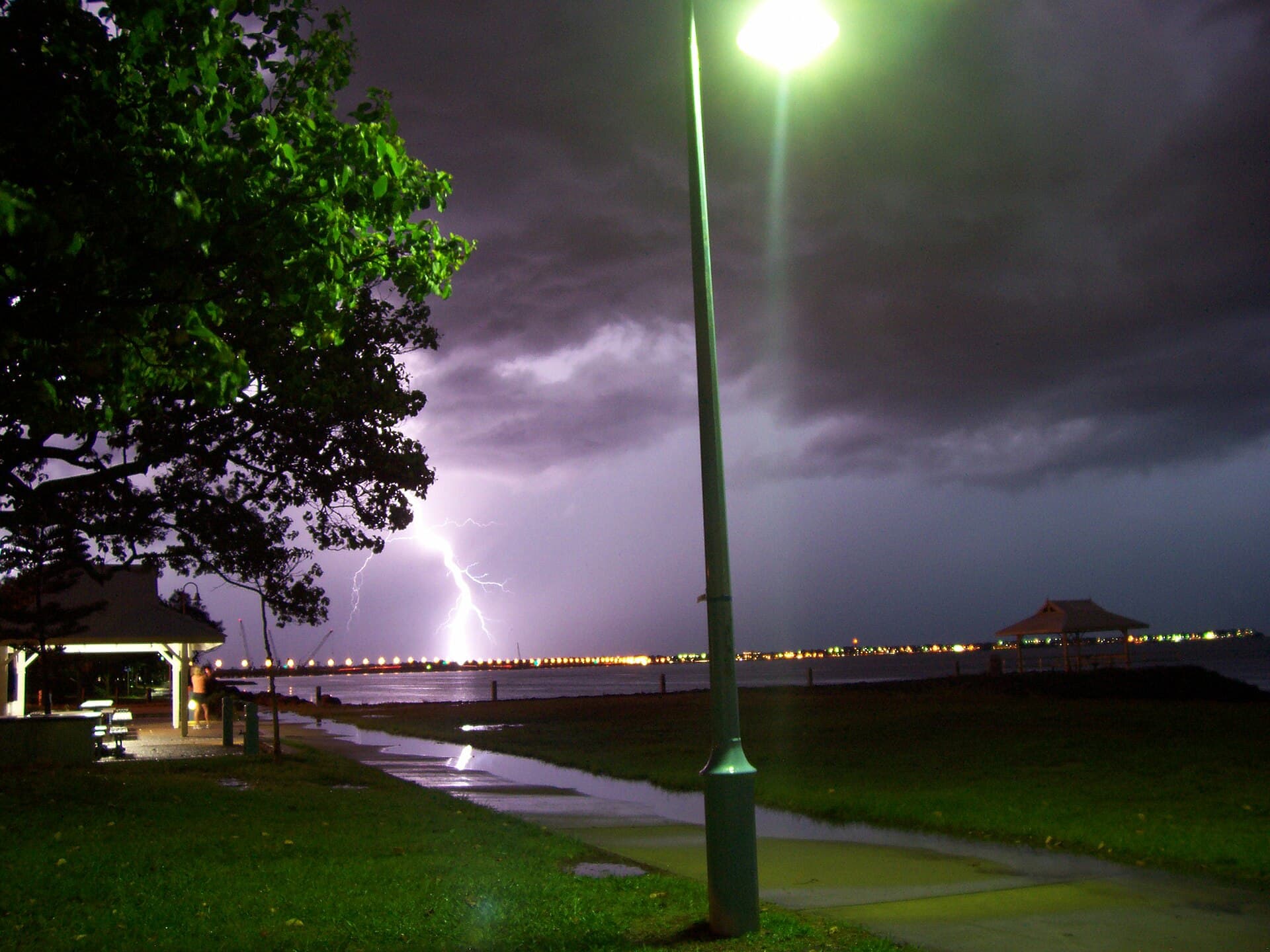
Storm light over Moreton Bay between Brighton and Redcliffe. Photograph: zpunout. CC BY-SA 3.0. Source: Wikimedia Commons. See the image credits page.
A calendar for Brisbane roofs cannot be copied from a temperate climate blog. We do not have a gentle autumn of decorative deciduous trees and a winter that reliably kills spores. We have a wet season that is really a storm season, a humid pause, a drier stretch that is never as dry as inland people mean by the word, and a spring that tries to do everything at once. Jacarandas drop in late spring. Figs drop whenever they please. Hail arrives with the same cells that make the evening news from Redcliffe to the Scenic Rim. Lichen likes the south pitches that never quite dry.
The useful calendar is therefore not a list of chores invented to sell four visits a year. It is a way of looking at the same roof as the year turns, so that you notice a failing valley in August rather than in the ceiling in February. It assumes a typical suburban house in the greater Brisbane and SEQ belt — tiled or metal, with trees, with gutters, with a body that would rather not climb. It also assumes that working at heights is still a regulated hazard. A monthly selfie from the ridge is not maintenance. It is a way to fall.
If the roof was restored in the last year, read this beside the first twelve months after restoration. A young membrane does not want the same sugar-soap enthusiasm as a ten-year-old film. If moss is already the main character, the longer essay is moss, lichen and mould in humid Queensland. This page is the year as a sequence.
January to March: storms, then the inspection you actually need
This is when the Bureau’s language turns to severe thunderstorms, and when Moreton Bay evenings produce the shelf clouds that make the photographs. The roof’s job is simple and brutal: take a lot of water in a short time, and get it to the downpipes without visiting the plasterboard.
After each serious cell, do the ground circuit. Look at the ceiling, especially along valley lines and around flues. Look at the overflow of gutters. Look at the splash marks on fascia and windows. Look at the driveway and paths for fresh grit, broken tile fragments, or rust flakes. If you have a metal roof, look from the ground for lifted screws and dinted pans after hail. If you have tiles, look for slipped units and broken corners at the edges.
Do not walk a wet roof. Tiles and lichen are skating rinks. Harnesses do not help a homeowner who has no rail and no plan. If something looks wrong at height, book a licensed person. The QBCC register — the old QBSA card by another name — is still the first filter. A canvasser who appears the morning after a storm, offering a free inspection and a same-day restoration, is not your calendar. They are their own.
Hail is its own column. Photograph everything before anyone sweeps it up: dents in metal, smashed tiles, bruised pointing, damaged skylights, pocked solar panels. Insurers and contractors will both ask. Do not let a well-meaning neighbour start “tidying” the evidence.
This is also when you learn whether last year’s coating was a system or a costume. Weeping at a painted-over valley is not a seasonal mystery. It is a specification that skipped iron. Keep notes. The wet-season timing of any new restoration work is a different question, dealt with in wet-season timing for restoration work. Maintenance in these months is mostly watching, photographing, and refusing to be hurried.
April to June: the pause that shows the damage
The storms ease. Humidity can still be high, especially near the river and the bay, but the roof is easier to see. This is the month-group in which you should look, properly, at what summer did.
Book a gutter clean if the summer storms filled the troughs with leaf mulch and granule. From a safe setup — not a dance along the eaves — look at valleys. They are the roof’s honest sentences. A valley that is rust-stained, holed, or packed with rotting litter will not wait politely until next January. Fascia and barge show their splits now, as timber dries a little. Eaves linings show the stains that tell you water has been behind them.
If you have a coated roof, look at the film without nostalgia. Chalking on a north or west pitch is ordinary ageing. Peeling in sheets is not. Hairline cracks in pointing along the ridge are common after a big summer; open, missing pointing is a call. Moss that established in the south valley through the wet months will still be there. Decide whether it is a watch-and-wait or a clean, and do not invent a bleach ritual on a young membrane.
Driveways and paths tell on the envelope. Mould that flourished in the wet will be obvious. The old trade used to pair roof work with driveway high-pressure cleaning for this reason: the house is one thing seen from the street. If you clean the path now, watch where the water goes, and do not bounce grit onto a roof you have just inspected. Asbestos caution still applies at old eaves and fibre-cement fences; a seasonal clean is not a licence to blast an untested sheet.
July to August: dry-season dust, grit and the long view
This is as close as SEQ comes to a dry season, and even then it can rain. Dust from western winds, grit from nearby works, and the fine litter of eucalypts and casuarinas settle in profiles and gutters. On metal roofs the dust holds moisture against the pans when a shower finally comes. On tiles it sits in the waterways.
Use the clearer weather to look at flashings, solar penetrations, and the junction between old and new roof planes. Look at the chimney or flue apron. Look at screw lines. Look at the ridge from the yard with binoculars if you have a two-storey house and no good reason to climb. This is also a decent window for any professional inspection that needs a dry film and a dry footing. Contractors who still work as owner-operators prefer it. They can see. They can stand without the afternoon cell arriving at two.
If you are planning a restoration for the coming spring, this is when you should be doing licence searches and specification conversations, not when the first October storm is on the radar. Canvassers know that spring panic is profitable. Your calendar should put the thinking in winter.
Working at heights, if you hire it now, should still include rails or harnesses and a method. Dry weather is not a substitute for edge protection. It only makes the method easier to run.
September to October: pre-wet-season checks
This is the most valuable short window in the year. Storm season is coming. Leaf drop from jacarandas is coming or already starting. Fig trees are making their own arrangements. You want gutters open, valleys clear, downpipes running, and any known defect either booked or documented for the insurer.
Walk the ground circuit again. Lift the little inspection points you can reach: the ends of gutters, the first metre of a downpipe, the overflow at a rainhead if you have one. After a short shower — not a storm — look at the ceiling. A leak that shows in a ten-millimetre fall will not become more charming in a fifty-millimetre hour.
If moss and lichen are heavy, decide now whether they will be cleaned before the wet, and by whom. A licensed crew with a method that respects tiles and membranes is one answer. A neighbour with a hired cleaner and a cheerful attitude is another. The second answer breaks more roofs than it saves. Pressure, chemistry and foot placement all matter. So does asbestos at the edges.
Solar owners should check that last summer’s installers did not leave unsealed holes, and that panels have not become a litter trap at the top edge. Body corporates should stop arguing about whose balcony planter is dropping soil into a common valley and actually clear the valley.
Write a short note to yourself: what looked worse than last April, what you booked, what you deferred. Next February’s ceiling stain is easier to understand if October’s note exists.
November to December: leaf drop, early storms, and the temptation to wait
Jacaranda litter is beautiful on the nature strip and miserable in a valley. Palm fronds arrive without poetry. Early storms test whatever you did in September. If you deferred a gutter clean because the family calendar filled up, this is when the downpipe becomes a fountain.
Keep doing the after-storm ceiling check. Keep refusing wet walks. Keep an eye on pointing that was marginal in August; heat and sudden water move ridges. If you have a newly coated roof, resist the urge to “touch up” marks with a leftover house paint. Touch-up is a system question. House paint is a stain that will weather as a patch.
This is also when driveway mould returns if the first-year clean was the only clean. The envelope is one system: roof, gutter, fascia, path. Water that leaves a blocked gutter blackens the barge and feeds the path. You can treat them as separate jobs. The house will not.
A roof in SEQ is not maintained by heroics in January. It is maintained by dull looking in August and a clear valley in October.
Across the whole year, keep the documents where you can find them: the restoration specification, batch numbers, warranty conditions, the licence search, any asbestos report on the eaves. Maintenance that voids a warranty is not clever. Maintenance that ignores a fibre-cement soffit is not thorough. The calendar is a habit of attention, not a second restoration sold four times.
If you do only three things, do these.
- After storms, look at the ceiling and the gutters.
- In the dry months, look at valleys and flashings while you can see them. The aftercare map of those joins is in gutters, valleys and flashings after the coating.
- Before the wet season thickens, clear the paths water is supposed to take.
Everything else — moss, coatings, solar, the neighbour’s fig — is a variation on those three. The thunderstorm will still arrive from the bay. The roof’s job is to be ready without you standing on it in the rain.
Questions from the verandah
- Do I need to climb the roof every month?
- No. Most of this calendar is ground work: gutters from a safe ladder or a service visit, downpipes, ceiling checks after storms, and looking at the eaves. Heights work is still licensed, harnessed work. Do not invent a monthly walk on a two-storey Queenslander.
- When should I book a professional clean?
- After the heaviest leaf drop and before the storm season thickens — often late winter into early spring — and only with a method that will not strip a young membrane or break tiles. Moss and lichen are a judgement, not a reflex.
- Is the dry season a rest period?
- It is a dust and grit period. Valleys still clog with casuarina needles and fig litter. Coatings chalk. Timber fascia shrinks and opens joints. Look then, while the roof is easier to see.
- What if I have just had a restoration?
- Follow the first-year rules first. Do not overlay an aggressive seasonal clean on a film that is still curing. Inspect, photograph, and call the original crew before you hire a second one.