Journal home / All articles / Aftercare and the envelope
Driveways, fascia and the rest of the envelope
The old Brisbane sites sold driveway high-pressure cleaning beside the roof because the house is seen as one thing. Fascia, barge, eaves and the path are not extras. They are where the roof’s water finishes its work.
Lila Nguyen · 8 September 2025 · Updated 24 August 2026
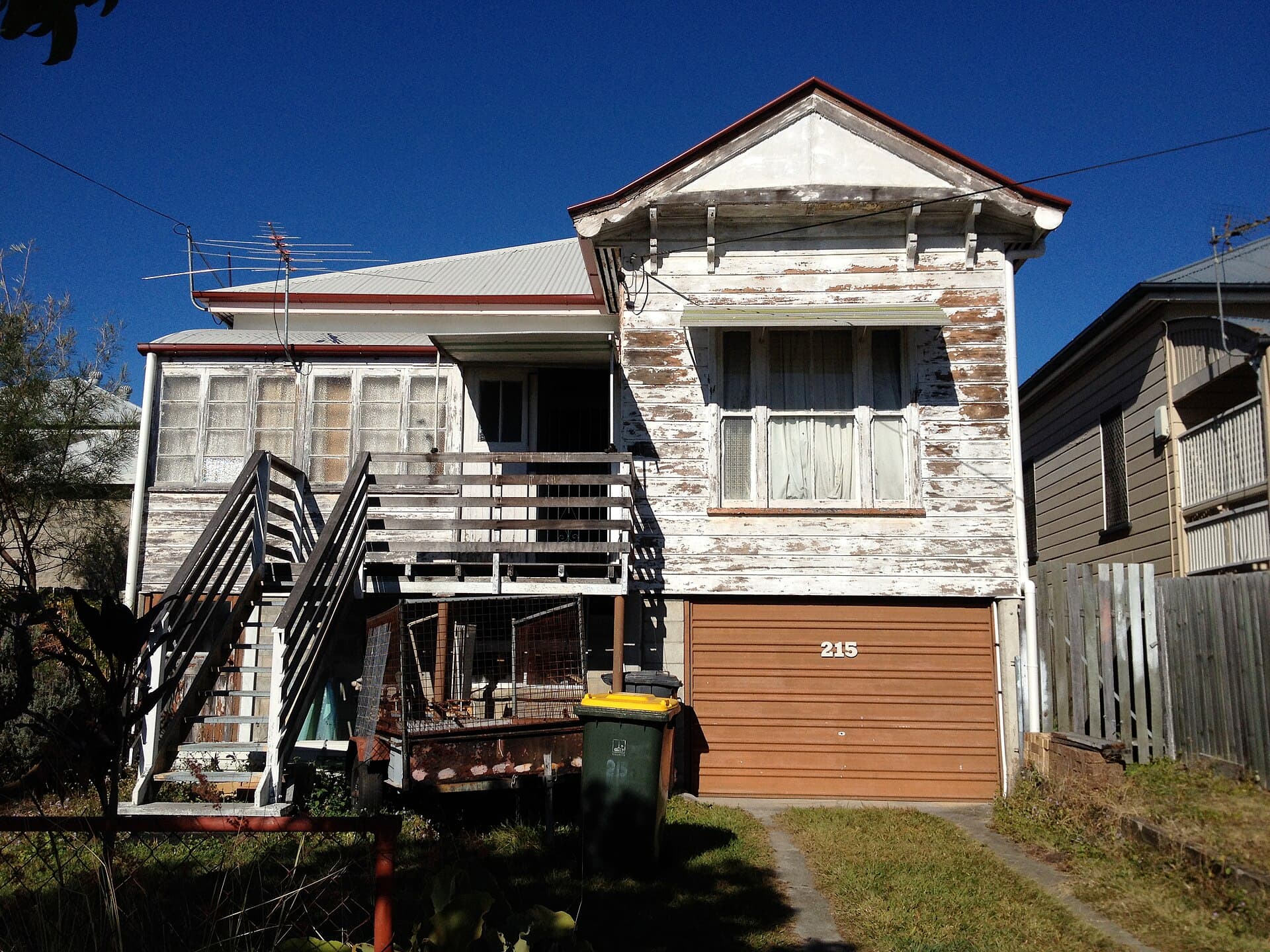
High-set Queenslander on a suburban Corinda street. Photograph: Kgbo. CC BY-SA 4.0. Source: Wikimedia Commons. See the image credits page.
Stand in a Corinda or Graceville street after rain and look at a Queenslander the way a passer-by looks, not the way a quote looks. You do not see a membrane system. You see a roof colour, a barge line, a verandah shadow, a set of stairs, and a path that is either honest concrete or a dark bloom of mould. The house reads as one weathered object. The trade, when it is thinking commercially, has always known this. The old Brisbane restoration pages — including the family site that once occupied this domain — sold driveway high-pressure cleaning with the roof as if the two were siblings. They are not siblings. They are neighbours in the same envelope. Water that leaves a tile has to go somewhere. If the gutter is open, it goes to the downpipe and away. If it is not, it goes over the fascia, down the wall, and onto the path that the flyer promised would look new.
Aftercare that stops at the ridge is only half a year of looking. The rest of the envelope — fascia, barge, eaves, verandah ceilings, paths, the odd fibre-cement fence that catches the splash — will tell you whether the restoration was a system or a photograph.
This is not an argument for blasting every surface because a pump is already on the truck. High-pressure water is a tool with a temperament. On tiles it can break arrises and drive water under laps; that method is a subject in itself in pressure cleaning tile roofs without breaking them. On a driveway it can feather old concrete, stripe a later patch, and send oily water into a garden bed. On an untested eaves lining it can do something worse. The envelope is one system. The method still has to be specific.
What the old combined offer actually understood
Owner-operators who wrote those early sites were not inventing a lifestyle brand. They had noticed, on job after job, that a client who had paid for a roof would stand at the letterbox and look at the path. Mould on south-facing concrete is ordinary in SEQ. Fig stain is ordinary. The black tide mark under a downpipe is ordinary. A newly coated terracotta roof above that tide mark looks like a hat on an unwashed face. Offering to clean the driveway was a way of finishing the visit, and a way of using a day of water and labour that was already rostered.
It was also a way of seeing drainage. A crew that washes a path sees where the roof is dumping. They see the downpipe that has come adrift. They see the garden that has been built up over the weepholes. They see the neighbour’s side path that is about to receive the runoff. Canvassers who add “driveway clean included” as a closing gift see a discount. The difference shows in whether anyone moved the cars and thought about the drain, or whether a lance was waved in a hurry so the signature would hold.
If you are offered the pair now, take the pairing seriously and the haste not at all. Ask whether the roof film can take the drift. Ask what will be done with the runoff. Ask whether the same person will look at the fascia while they are there. Ask whether any fibre-cement — eaves, a side fence, an old laundry wall — will be left alone until it is identified. A combined offer that cannot answer those questions is a combined risk.
Fascia, barge and the timber line
The barge is the roof’s eyebrow. The fascia is the board that carries the gutter. In Brisbane they are often timber, sometimes replaced with metal, sometimes a mix after a later gutter job. They take ultraviolet light, overflow, and the particular rot that arrives when a gutter sits full of mulch against paint. A restoration that recoats tiles and leaves a gutter full of acrylic is already writing a stain onto the fascia. A restoration that never looked at the barge mitres is leaving a split for the next storm to open.
After the coating, look at the timber line as if it were part of the specification. Fresh overflow marks mean the gutter is not coping or not falling. Dark ends at mitres mean water is getting in. Peeling on the underside of the barge can mean the roof edge is driving rain back, or that the last paint system has given up. None of this is fixed by another membrane on the tiles. Some of it is fixed by clearing outlets. Some of it is a carpentry or painting job that should be sequenced after the roof, so that the new barge paint is not used as a drop sheet.
Eaves and verandah ceilings are the quiet record. They show old leaks as brown maps. They show condensation. They show, on older houses, the painted fibre-cement that may be asbestos-containing. A new roof colour makes those maps more obvious, the way a clean shirt shows a stain. Do not immediately high-pressure them into cheerfulness. Identify the sheet. If it is sound and not being cut, a gentle clean or a later paint may be enough. If it is damaged, you are in stop-and-test territory, not aftercare theatre.
Working at heights applies at the eaves as much as on the pitch. A two-storey fascia is not a stepladder job. Harnesses, rails or a proper scaffold are still the difference between maintenance and an ambulance. A QBCC licence — the old QBSA card in the language of earlier quotes — still sits behind anyone who contracts to replace a barge or recut a gutter. The envelope does not dissolve the regulator.
Mould on paths, and what the path is telling you
South-facing concrete in a damp inner suburb will grow a film. So will a path under a dense mango or a poorly drained side gate. Some of that is climate and shade. Some of it is the roof. If the bloom is worst under a particular downpipe, the downpipe is the story. If it is a tide along the whole frontage after every cell, the gutters are overtopping. If it is a rusty smear, a valley or a metal fascia is contributing.
Cleaning the path without reading it is how you get a handsome week and a returning stain. Read it first. Then clean it in a way the concrete can stand. Older Brisbane driveways are uneven, patched, sometimes painted, sometimes stamped in a later fashion that marks if you are heavy-handed. Test a corner. Watch the runoff. Keep the lance away from window seals, weepholes and any sheet you have not named.
Mould on a path is not a moral failure, and it is not automatically a slip hazard you can ignore. After rain it can be both a stain and a skating rink on the way to the bins. Aftercare can be as plain as a scheduled clean at the end of the wet months, recorded in a seasonal maintenance calendar for SEQ roofs, rather than a panic blast whenever visitors are coming.
If the restoration crew cleaned the driveway as part of the job, note the date. The first twelve months will tell you how fast the bloom returns, and whether a drainage fix would do more than a second wash. That is useful information. It is also a reason not to sign a yearly “whole of house blast” with a canvasser who has never looked at the downpipes.
Why the envelope is one system
Roofs do not end at the last tile. They end where water stops being the roof’s problem. That might be a lawful connection to stormwater. It might be a rubble pit that has silted up. It might be the neighbour’s azaleas. The fascia, the path, the weepholes and the subfloor vents of a high-set house are all in that conversation. So is the garden bed that has been built up against a timber stump. So is the air-conditioning condensate that drips onto a stair and grows its own moss.
A restoration that is only a film is still worth doing when the tiles were porous and the pointing was open. It is not the whole maintenance of the house. After the job, the useful habit is to look along the water.
- From ridge to valley to gutter to downpipe to drain or garden.
- From overflow to fascia to wall to path.
- From eaves lining to the room below, if the lining is stained.
- From solar penetrations to the ceiling, if a later trade has been on the roof.
- From the path back up, if a clean has revealed a rusty or oily source.
If you find a break in that chain, you have found the next job. It may be a call-back to the original crew. It may be a roof plumber. It may be a drainage plumber. It may be a painter. It may be an asbestos assessor at an eaves sheet that was never part of the quote. The envelope is allowed to involve more than one licence. What it is not allowed to do is pretend that a colour on the tiles closed the file.
A house is weathered as a whole object. Restoration that forgets the eaves and the path has only restored the part that photographs well.
How to live with the envelope after the trailer leaves
Keep the folder that the other aftercare essays keep asking for: specification, batches, warranties, licence search, any material report. Add to it a photograph of the path and the fascia on the day the crew finished. In six months you will be glad of the comparison. Follow the walking and call-back rules in the first twelve months after restoration. Do not invent a monthly ritual with a hired cleaner. Do not let a later painter use the new membrane as a drop sheet without masking. Do not let a solar crew treat the barge as a step.
If mould returns fast, look up before you look down. If the barge splits, look at the gutter before you look at paint colours. If the verandah ceiling maps a new stain, trace it as a leak, not as a reason to reclean the boards. If someone offers to “do the whole house for a price you wouldn’t believe”, ask which QBCC classes they hold, what they will do at height, and what they will do if the eaves are fibre-cement. The answers will sort the owner-operators from the people who only brought a pump.
The old combined offer was, at its best, an instinct toward completeness. A roof, a gutter, a path, a house that looked tended. At its worst it was a way to add a line item and a lance. Aftercare is how you keep the instinct and refuse the lance when the surface does not want it. Look at the envelope as one thing. Treat each surface as itself. That is a more Brisbane sentence than any flyer, and it will still be true the next time a storm comes up the river and the path shows you where the water went.
Questions from the verandah
- Why did old restoration sites bundle driveway cleaning?
- Because a newly coated roof above a mouldy path looks unfinished, and because the crew already had the water, the pump and the day. It was a practical pairing, not a philosophy. It still only works if someone looks at what the lance will hit.
- Can I clean the driveway the same day as the roof?
- Sometimes. Not if the membrane is still young and the drift will mark it, not if the water will run into a neighbour’s garden unannounced, and not if the eaves lining has not been identified. Sequence is part of the method.
- Is fascia part of a roof restoration?
- Only if the quote says so. In practice a blocked gutter or an overflowing eaves will stain fascia immediately, and a restoration that ignores that stain has only finished the tiles. Ask for the envelope to be named.
- What should I do in the first year?
- Watch the path, the barge and the eaves after storms. Do not invent a monthly blast. Follow [the first twelve months after restoration](/articles/first-twelve-months-after-restoration) for the film, and this page for the surfaces the film sheds toward.