Journal home / All articles / The restoration process
Pressure cleaning tile roofs without breaking them
A pressure washer is a tool, not a personality. On Brisbane tiles the difference between a clean roof and a broken one is PSI, distance, the clay or concrete under the nozzle, and whether anyone thought about the gutters and the solar glass.
Tom Birtles · 2 April 2025 · Updated 18 July 2026
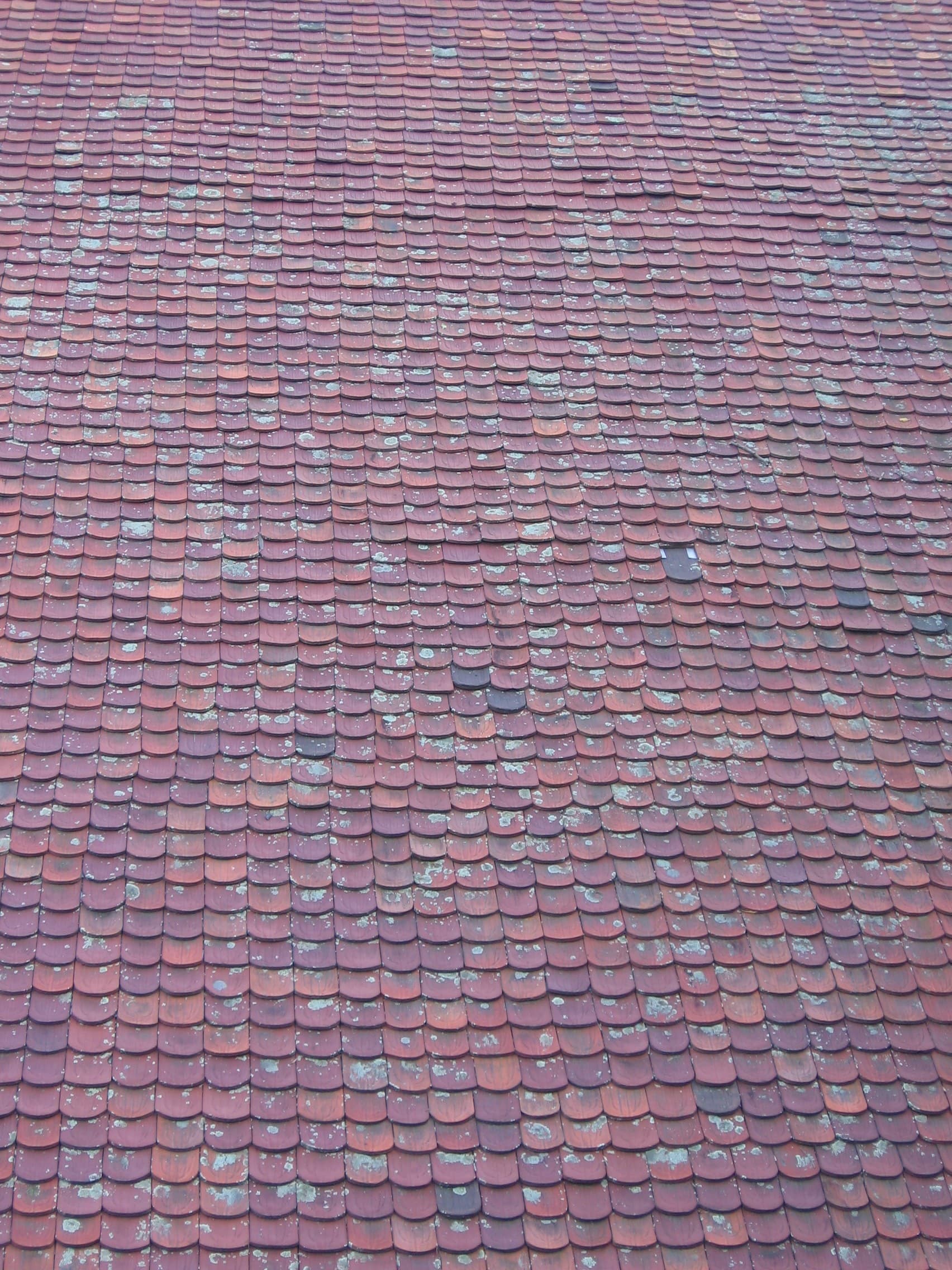
Close view of weathered concrete roof tiles. Photograph: PookieFugglestein. CC0. Source: Wikimedia Commons. See the image credits page.
A pressure washer on a tile roof sounds like competence. Water, dirt, a machine that makes a noise people associate with work. In Brisbane it is also one of the easier ways to turn a restoration into a pile of broken corners and a ceiling stain that was not there on Monday. The tiles were already tired. The lichen was holding a few of them together. The operator was in a hurry because the coating truck was booked for Wednesday.
This is not an argument against washing. A membrane will not stick to a roof that is still wearing last decade's mould and the chalk of a failed paint. The anatomy of a restoration puts the wash after the broken work is marked and, ideally, after the ridges are reset. What the anatomy cannot do is make the wash gentle. That is on the person holding the lance, and on whoever decided that terracotta in Ascot should be treated like a driveway in Regents Park.
PSI is a starting rumour
Hire-shop stickers and contractor talk still orbit a number. Two thousand PSI. Fifteen hundred. Three thousand for the stubborn stuff. The number is not meaningless, but it is not a specification. Pressure at the nozzle depends on the machine, the hose length, the tip, and how much the operator has wound the unloader down. A wide 25-degree fan at a metre and a half is a different event from a 15-degree tip at thirty centimetres, even if both come out of a machine labelled the same.
Concrete tiles, the ones that cover so much of Aspley, Sunnybank Hills and the 1980s estates out toward Karalee, are porous and comparatively tough. They will still lose a corner if the jet finds a crack that ice — or more often, a boot — started. They will also drink a remarkable amount of water. A hard wash can leave a concrete roof looking new and feeling like a sponge. Coat too soon and you have trapped moisture under a film that will blister when the first hot day of October arrives.
Terracotta is another material wearing the same job name. Older Marseilles profiles on Queenslanders in Chelmer, Corinda and Clayfield can be sound, or they can be shortbread. You do not always know until the water hits. A jet that a concrete tile shrugs off will open a terracotta arris and send a shard into the gutter. That is why experienced crews talk about distance before they talk about PSI, and why they walk the roof after the first pass instead of assuming the wash was only cosmetic.
Distance, angle and the hand that gets tired
Hold a fan tip too close and you are not cleaning. You are cutting. The safe habit is a wide fan, a shallow angle, and a distance that looks lazy from the street. Work down the tile, not against the overlap, so you are not driving water up under the headlap and into the batten space. That last mistake is how a wash becomes an indoor leak without anyone breaking a tile.
Operators get tired. A lance is heavy, a roof is hot, and the last pitch of the day is when the nozzle drifts closer because closer looks faster. Supervisors who care about tiles watch the last hour as closely as the first. The rest watch the clock.
A clean tile that has lost its corner is not a clean tile. It is a replacement you now have to source, on a profile the yard may not hold.
Porous concrete and the water it keeps
Concrete tiles in South East Queensland fade, roughen and grow a surface that holds moisture like a poorly fired brick. Lichen and moss like that surface. So does a washer. The dirt comes off. The pores fill. On a low-set in Geebung you can sometimes see the tiles darken and stay dark into the next afternoon. That is not a stain. That is water.
A restoration schedule that puts sealer on a damp concrete roof is a schedule written for the diary, not the film. Drying time is not a moral quality. It is a function of breeze, shade from a neighbouring mango, and whether March decided to be humid. Crews that work this climate leave a margin. Crews that do not write the blister into the job.
There is a related habit: washing a roof and leaving the slurry to cake in the gutters overnight. Concrete dust and organic muck will set. Downpipes in Greenslopes and Birkdale have been opened, years later, on a plug that began as a Friday wash. Flush as you go. Flush again when you finish. If the property falls to a rainwater tank, say so before the first trigger pull. Nobody wants a tank that tastes like a roof.
Terracotta, heritage and the case for stopping
Terracotta on an interwar house in New Farm or a Queenslander in Shorncliffe is often part of why the house was bought. It is also often past the age at which a hire-shop washer is a reasonable guest. Glaze, where it remains, can be etched. Unglazed bodies can be more porous than they look. A tile that has already lost its neighbours to a storm is not looking for a test of character.
Soft wash — a chemical application, a dwell, a low-pressure rinse — is not a miracle and it is not automatically greener. It is a way of getting biology off a brittle surface without using the jet as a chisel. It needs the right product, the right dwell, and a plan for what runs to the garden and the stormwater. It is slower. It is often the reason a heritage terracotta roof is still a terracotta roof after the restoration, rather than a patchwork of new pieces that do not quite match.
Some roofs should not be washed hard at all. If the inspector can lift crumbs from an edge with a thumb, the washer is not the next tool. The next tool is a conversation about replacement tiles, or about whether this house has already crossed into a different job.
Moss, lichen and the living roof
South East Queensland grows things on roofs the way it grows things on the south side of a fence. Lichen on a south and east pitch in Cleveland or Gumdale is not a moral failing. It is climate. Moss in a shaded valley is the same climate with more water. Both hold moisture against the tile and both, when they die, leave a surface that still needs to be rinsed.
A hard jet will strip moss in a satisfying sheet. It will also strip the tile face if the moss was the only thing filling a crack. This is one reason moss, lichen and mould in humid Queensland belong in the inspection, not only in the wash. If the growth is thick, treat the first pass as investigation. You may be about to discover how many tiles the biology was keeping in place.
Biocide after a wash is a separate decision. Some coating systems want a clean, dry, chemically quiet surface. Some owners want the lichen gone and nothing else. Read the data sheet. Do not invent a chemistry because the drum in the trailer is leftover from a driveway.
Gutters, downpipes and the flood you scheduled
A washer puts more water on a roof, faster, than most storms. It also puts it there with dirt. Gutters that handle a summer cell by a slim margin will not handle a wash. They overtop. They put dirty water over the fascia and onto the verandah. They find the rusted bracket and the joint that was only just holding.
Before the machine starts:
- Open and test the downpipes, or accept that you are about to test them the hard way.
- Know where the water goes — tank, stormwater, or a neighbour's garden in a low-set street.
- Move cars, cover a/c units, and tell the person who owns the frangipani.
- Have a plan for the valley troughs, which will run like creeks.
On a two-storey in Clayfield the flood is also an access problem. Someone has to be able to see the gutter while someone else is on the roof. A crew of one with a washer and optimism will learn about overflow from the downstairs window.
Solar glass, overspray and the neighbour
Solar arrays have turned a simple wash into a specialist annoyance. The glass does not want a close jet. The frames do not want grit driven under the rails. The inverters and isolators do not want a bath. Overspray that dries as a mineral film on a panel is a service call, not a patina.
Work away from the array. Mask what you can. Keep the fan off the glass. If the roof is so covered that you cannot wash the tiles without washing the panels, say so and change the method. Soft wash along the rails, hand work, or a clean that leaves a strip the coating will have to treat as an edge. What you should not do is pretend the panels are just dark tiles.
Overspray travels. A northerly in Redcliffe will take concrete dust across a street. Painted eaves, cars, pool water and a neighbour's newly oiled deck are all in play. The old crews knew this because they had been yelled at. The new ones learn it the same way unless someone writes it into the morning.
Windows, especially on high-sets where the roof wash runs down a wall, need a rinse before the slurry dries. A restoration that leaves tiger stripes on a Queenslander weatherboard has not finished. It has only finished the roof.
When soft wash is the safer sentence
Soft wash is safer when the tiles are terracotta and old, when the inspector can crumble an edge, when solar coverage makes a jet a liability, or when the house sits so close to its neighbours that overspray is a legal letter. It is also safer when the forecast is a series of small showers and you would rather not drive storm-level water into a half-blocked gutter twice.
It is not safer if the chemistry is a mystery drum and the garden is a tank supply. It is not faster. It will not impress anyone who thinks a restoration is not real unless it sounds like a freeway. It will, on the right roof, leave the tiles intact, which is the only clean that matters.
Wet-season timing belongs in the same decision. A wash in a humid January may be possible at ten in the morning and foolish by two. A wash in a dry August is easier on the diary and harder on the dust. Choose the week for the whole sequence, not for the machine.
A short discipline for the person on the lance
Walk first. Mark the broken and the thin. Choose a wide fan and a distance that would look excessive in a video. Keep the jet off the headlap. Watch the gutters. Stop when a tile changes its sound. Do not chase a stain into a crater. Flush as you go. Leave solar and glass alone. Let concrete dry longer than your optimism wants.
The wash is the loudest hour of a restoration and the easiest to do badly. Done well, it is almost invisible in the finished job — a roof that is simply ready for pointing and a film. Done badly, it is the reason the owner has a new leak and a pile of terracotta in a trailer. Brisbane has enough weather. It does not need help from a nozzle.
Questions from the verandah
- What pressure is safe on a Brisbane tile roof?
- There is no single safe number, because nozzle, distance and tile type matter more than the sticker on the machine. Concrete will usually tolerate more than terracotta, and both will fail if the fan is held at close range.
- Should terracotta be pressure cleaned at all?
- Sometimes, with a wide fan, plenty of distance and a crew that will stop when a tile rings wrong. On brittle or heritage terracotta, a chemical soft wash is often the less destructive clean.
- Why do gutters flood during a roof wash?
- Because a washer puts more water on the roof, faster, than a storm, and it carries slurry. If the downpipes are half-blocked, that water has nowhere civilised to go.
- Can you wash around solar panels?
- You can, if you treat the glass as something you are not allowed to etch, flood or coat with overspray. Many crews mask, work away from the array, or leave a soft-wash strip along the rails.