Journal home / All articles / Climate and weather
Wet-season timing for restoration work
Between October and March, Brisbane roofs are in a climate that does not forgive a rushed coat. Dew points, afternoon cells and the radar on a supervisor’s phone decide more jobs than the colour chart.
Meredith Keane · 2 May 2025 · Updated 25 July 2026
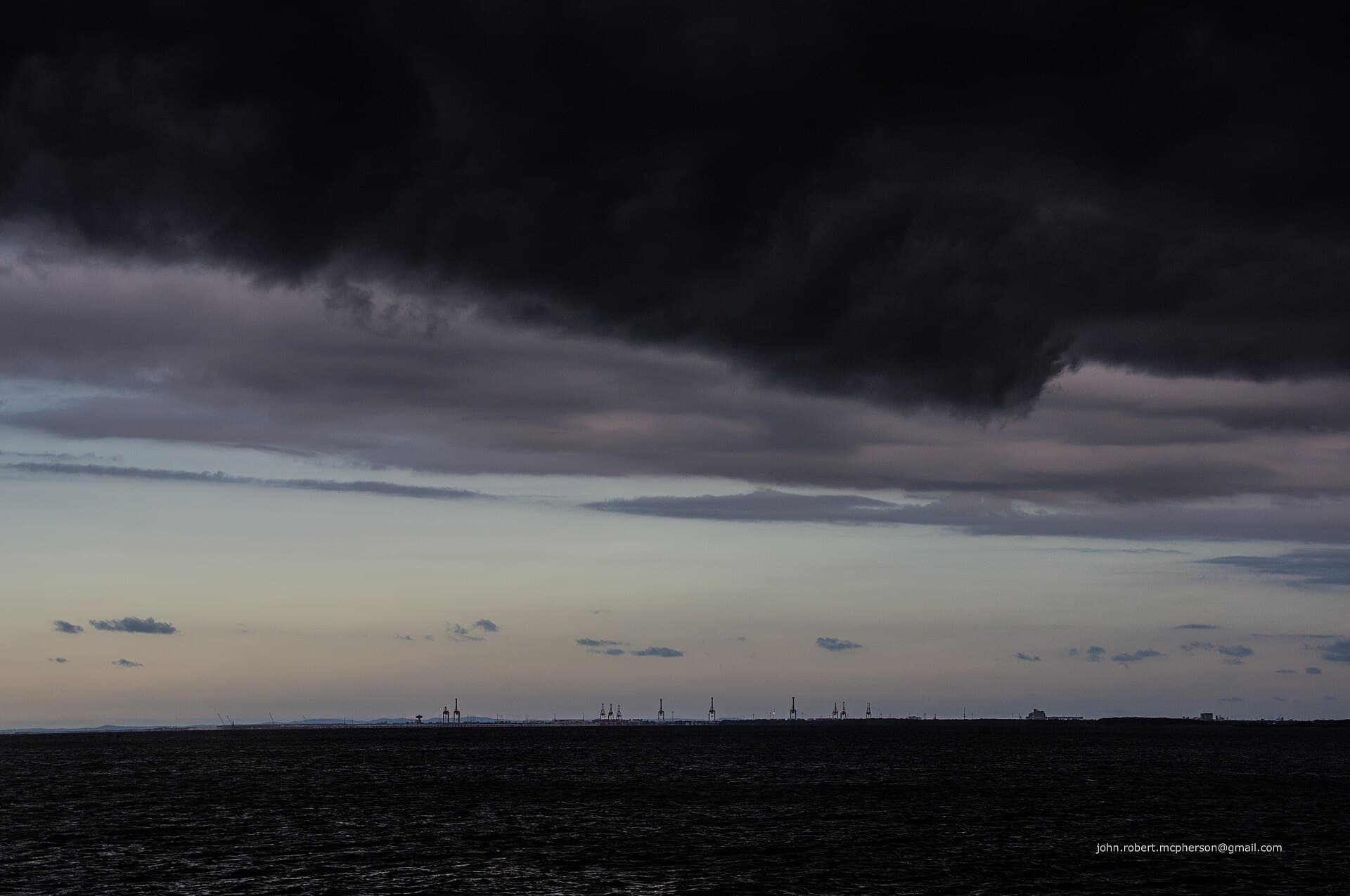
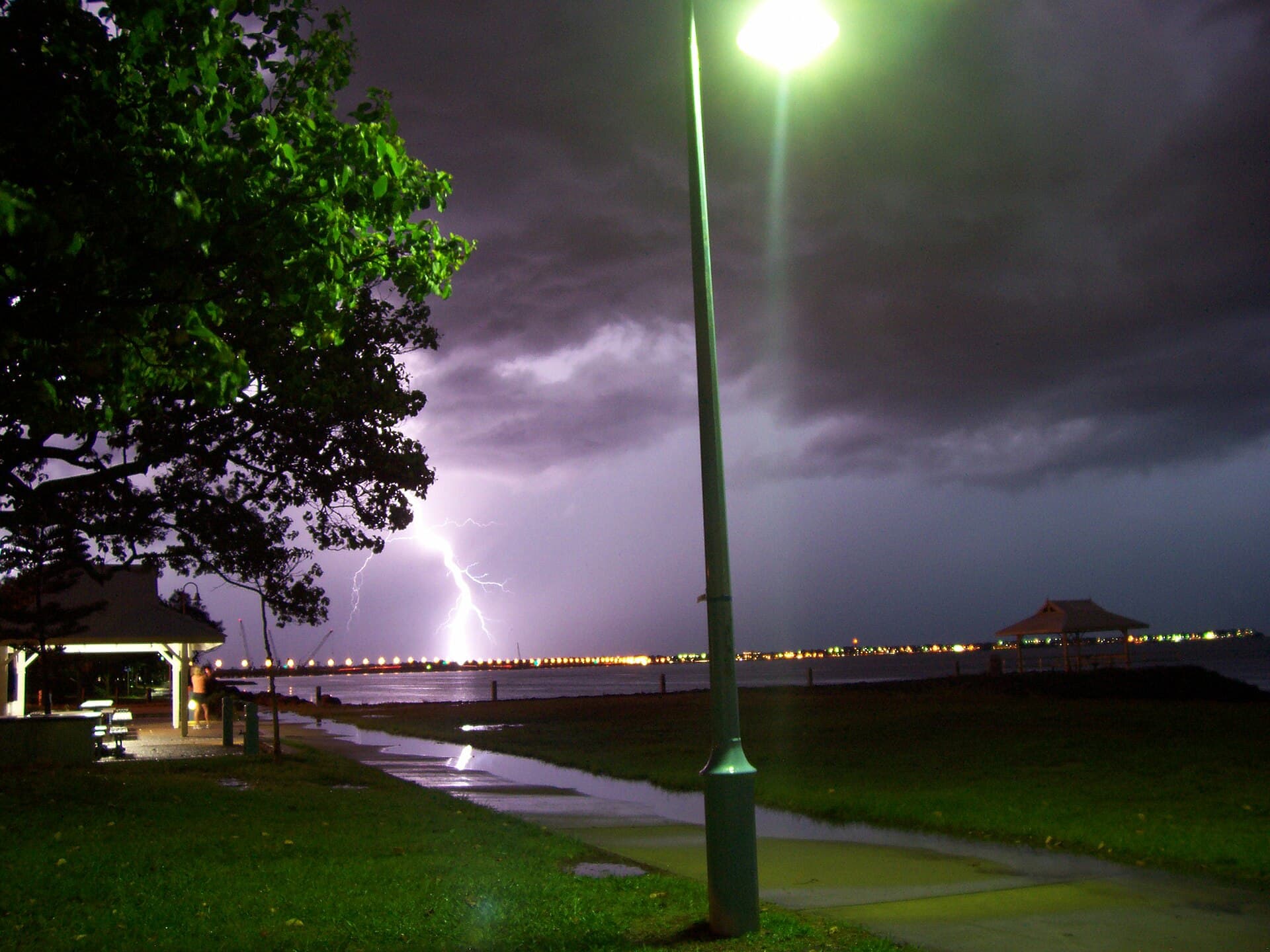
Evening thunderstorm shelf cloud over Bramble Bay, seen from Shorncliffe Pier. Photograph: John Robert McPherson. CC BY-SA 4.0. Source: Wikimedia Commons. See the image credits page.
There is a particular quiet on a January roof in Brisbane at twenty past two. The light has gone a bit green. The wind has flipped. Someone’s phone has a radar blob over the Lockyer that was not there at smoko. The crew is already folding the drop sheets. From the street this looks like knock-off. From the roof it is the only adult decision left.
The wet season in South East Queensland is not a date on a tourism brochure. It is a working climate: high dew points at dawn, a short honest drying window, and afternoon storms that treat a half-cured membrane as an invitation. Restoration work can still happen in these months. A lot of it should not, and almost none of it should happen on the schedule a canvasser wrote in September.
This is a timing essay. The physics of the cells themselves are in how subtropical storms punish Brisbane roofs. The sequence of a competent job is in the anatomy of a Brisbane roof restoration. The chemistry that needs those dry hours is in membrane coatings, primer, sealer and topcoats. What follows is the calendar those other essays assume.
October to March, without the romance
People in this city speak of the build-up. The storms start to mean it in October. By November the afternoon cell is a character in the suburb. December and January are the months when a western pitch in Oxley can be dry enough to coat at ten and foolish to coat at two. February is still a wet-season month, whatever the school calendar says. March is a negotiation: some years it behaves like autumn, some years it throws a last, spiteful trough at the coast.
The risk is not only rain on the day. It is moisture in the substrate, moisture in the air, and the shortness of the period when both are low enough for a film to do what the data sheet promised. A concrete tile that looks dry can still hold last night’s rain in the body of the tile. A steel roof can be above the dew point at the crown and wet at the laps. The applicator who checks only the sky is reading the wrong instrument.
Hail and wind do not respect the coating diary either. A job washed and pointed in the first week of November can be waiting for a topcoat when the first severe cell of the season arrives. If the pointing is still green, or the primer still tender, the cell is not “bad luck”. It is the season doing what the season does. Emergency making-safe after that cell is one job. Continuing the restoration as if the calendar had not spoken is another.
The bayside has its own clock. Shorncliffe, Sandgate, Redcliffe and the islands see the shelf clouds coming across the water like a sentence you can read in advance. Inland suburbs — Ipswich, Springfield, the ridges toward Samford — often cop the earlier punch. A crew that works both in one day is working two climates. The quote that assumes they are the same climate is already late.
Dew point, not just rain
The word that should appear more often on restoration quotes is dew point. When the roof surface is at or below the temperature at which the air gives up water, you have a film of moisture whether or not the Bureau has issued a warning. In a Brisbane summer, that condition is common at dawn and not rare in the shade of a southern pitch at nine.
Coatings applied over dew do not always fail dramatically. Sometimes they fail as a blush, a poor bond, a primer that never quite keyed, a topcoat that skins and then remains soft underneath. The first person to notice may be the owner, six months later, when a western wall of tile in Sunnybank Hills begins to chalk in sheets rather than in a polite dust.
Practical timing, if you are the one who has to live with the film:
- Start after the roof has actually dried, not after the crew has arrived. In midsummer that may mean a later start than the traffic prefers.
- Treat south-facing and tree-shaded pitches as a different clock from the northern hip in full sun.
- Do not let a second coat chase the first because the diary has a driveway clean booked tomorrow in another suburb.
- If the night will be still, humid and warm, assume the morning is a dew morning even if the forecast is “fine”.
- Metal roofs can hide wet laps. Tiles can hide wet bodies. Both deserve a hand, not only an eye.
None of this is mysterious to a good supervisor. It is mysterious to a sales process that sold a three-day package in the wet season and now has to invent weather.
The coating window is a few honest hours
Manufacturer data sheets talk about recoat times, temperature ranges and humidity limits as if the roof were a panel in a shed. A roof in Camp Hill in December is not a panel in a shed. It has a moving sun, a sea breeze that may or may not arrive, and a neighbour’s sprinkler. The useful coating window might be four hours. It might be two. It is almost never the eight-hour day implied by a labour line on a quote.
A full membrane system — cleaner, repairs, primer or sealer, then topcoats — is a chain of those windows. Break one and you have not saved a day. You have spent the system. This is why wet-season restorations, when they are done well, look inefficient from the street. The crew is there, then not there, then there again on Thursday when the trough has gone out to sea. The inefficient-looking job is often the one that will still be a film in five summers.
There is also the wash. Pressure cleaning a tile roof loads the envelope with water. In July you can sometimes wash on Monday and prime on Wednesday. In January you can wash on Monday and still be waiting on Friday, especially if a cell has come through on Tuesday night. Anyone who promises a wash-and-coat in forty-eight hours in the wet season is promising you their diary, not the tile.
Pointing has its own clock. Cementitious and flexible systems both need to set or cure before they are asked to be a ridge in a storm. A ridge pointed on a humid morning and rained on at three is a ridge you may meet again. The cost of waiting is a few days. The cost of not waiting is a callback that will be argued as “storm damage” when it is timing damage.
Why crews vanish after lunch
The radar is now a trade tool, as ordinary as a caulking gun. A supervisor who watches a cell build over the ranges and keeps spraying is not brave. They are spending someone else’s warranty.
Afternoon storms in this climate can go from a bright sky to a shelf cloud in the time it takes to finish a hip. Wind arrives first. Dust and leaves arrive with the wind. Then rain rates that overwhelm the gutters you have just cleared. A wet film in that sequence picks up the debris of the suburb — Jacaranda litter in Red Hill, paperbark strings in Wynnum, the fine grit of a neighbouring blast — and locks it in. The finish will look like the storm even if the bond survives.
So the crew leaves. They should leave. If they are a serious crew they will have planned the day knowing they might leave. That means they did not open a drum of topcoat at one o’clock on a day the models were already twitching. That means the owner was told, at the start of the job, that weather can take the afternoon. The crews that do not say this in advance are the ones that later say it as an excuse.
Night work is not the answer. Lights on a roof do not change the dew point. They change the accident rate. This is a heights trade in a humid city. Fatigue and a slick membrane are a pair you do not need.
What can be done in the wet months
Not everything waits. A lifted sheet after a January cell cannot wait for May. A missing tile over a child’s bedroom cannot wait. Making-safe, tarping, replacing a shattered unit, clearing a valley that has become a creek — these are wet-season jobs by definition. They should be priced and scoped as emergency work, not used as the opening scene of an unsolicited restoration.
Inspection can happen almost any week. A good inspection in the wet season is, in some ways, better than one in August, because the roof is in the climate that will test it. Stains are fresh. Gutters are honest. The southern pitch is showing its moss. You just should not confuse an inspection with a start date.
Preparation that does not depend on a curing film can sometimes proceed: access, safety, the order of a replacement valley, the argument about colour. Even then, washing remains a water-loading event. Think before you wet a roof you cannot dry.
If a full restoration must happen between October and March — an insurance timeline, a sale, a leaking winter already behind you — write the weather into the contract. Name the stop-work rule. Name the recoat rule. Name the fact that “three days” may become three weeks. A contractor who refuses that language is not offering you speed. They are offering you a fight in April.
A few timing rules that survive contact with the radar:
- Prefer the dry half of the year for membrane systems unless there is a leak that cannot be made safe.
- In the wet season, book mornings and accept afternoons as provisional.
- Do not wash more roof than you can reasonably prime in the next honest window.
- Keep solar and trades off a newly coated roof until the film has had the time the sheet asked for, not the time the agent asked for.
- If two quotes differ by a week of calendar and a kilometre of care, the slower one may be the only one that has met January before.
Living with a city that storms at three
Brisbane will not stop being subtropical because a diary needs a coating week. The bay will keep feeding the air. The ranges will keep triggering the cells. The UV will keep cooking whatever you apply in the hours the storms leave you.
The householder’s job is not to become a meteorologist. It is to stop treating weather as an interruption to a restoration, and start treating restoration as an activity that fits inside weather. Ask when they will not work. Ask what they do when the blob is over Ipswich at noon. Ask how many days they actually expect, in February, between a wash and a last coat. The answers are more useful than the colour names.
A film that was allowed to dry in the few honest hours this climate offers is worth more than a job that looks complete in a photograph taken at four, just as the first heavy drops arrive from the west.
When the crew vanishes after lunch, let them. Walk downstairs. Watch the shelf cloud from the verandah if you have one. The roof you wanted finished today is the same roof that has to survive the next five wet seasons.
Questions from the verandah
- What months are worst for coating a roof in Brisbane?
- The wet season, roughly October to March, is the riskiest window. November through February combine high dew points, short drying hours and regular afternoon storms. April to September is usually kinder, though late spring can still throw a cell at a half-finished job.
- Why did the crew pack up after lunch even though it was still sunny?
- They were likely reading a storm that had not arrived yet. A cell west of the city can be on a Brisbane roof in the time it takes a topcoat to skin. Leaving is professionalism, not a slight. Chasing a second coat into a three o’clock downpour is how membranes fail in year one.
- Can you restore a roof during the wet season at all?
- Yes, on the right days, with the right start time, and with a willingness to stop. Emergency repairs cannot wait. Full membrane systems can wait more often than sales diaries admit. The specification should say so.