Journal home / All articles / Climate and weather
How subtropical storms punish Brisbane roofs
Afternoon cells, wind-driven rain and a sudden drop in temperature do more to a Brisbane roof in twenty minutes than a month of ordinary weather. Here is how the punishment actually works.
Asha Varghese · 18 February 2025 · Updated 1 August 2026
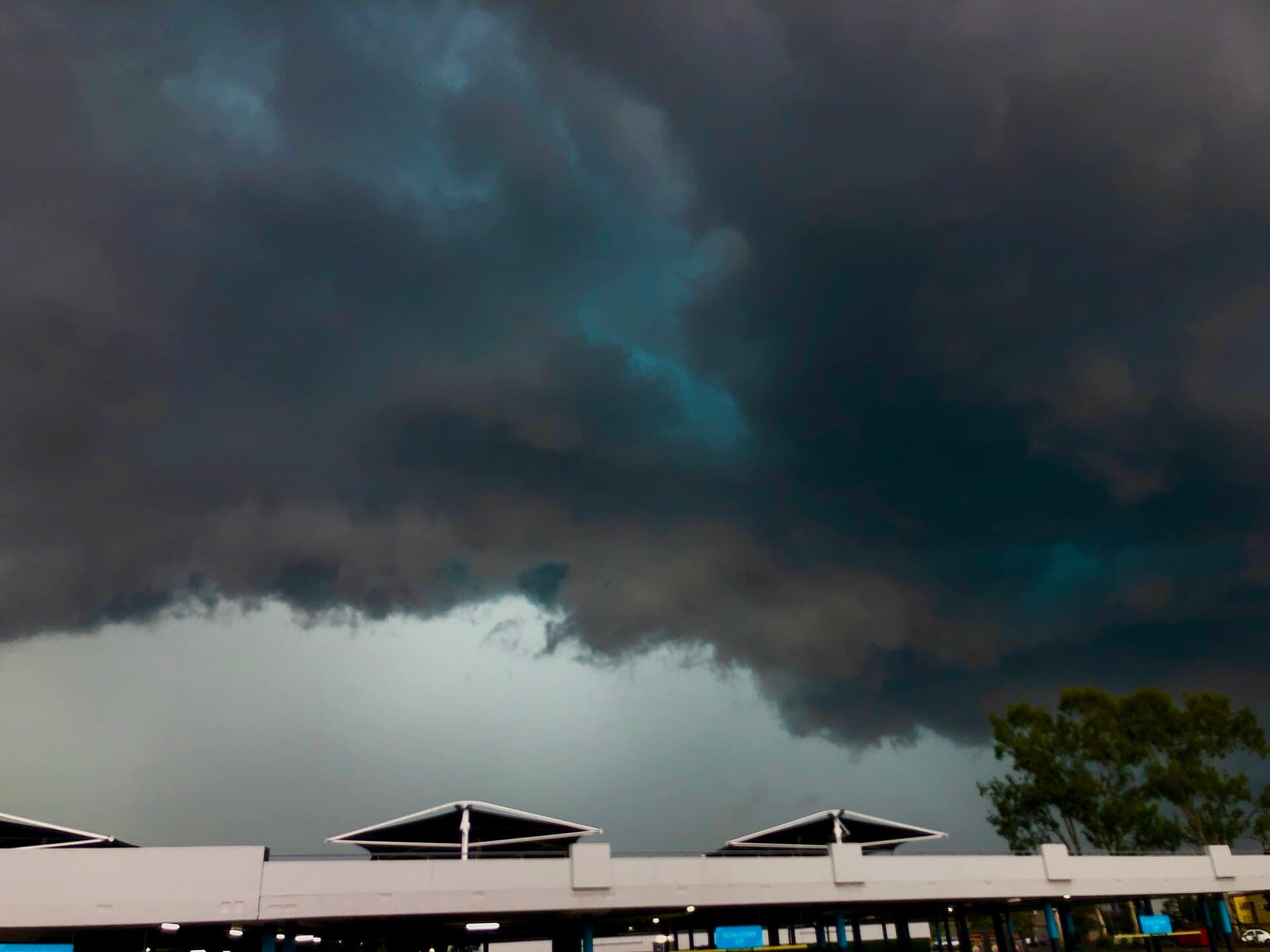
A shelf cloud moving across eastern Brisbane. Photograph: FinletAu. CC BY-SA 4.0. Source: Wikimedia Commons. See the image credits page.
Brisbane does not have a winter storm season in the southern sense. It has afternoons. From late spring through the wet months, the city builds heat over bitumen and tin, draws moisture off Moreton Bay, and then, with a regularity that still startles people who grew up elsewhere, throws a thunderstorm at the western and southern suburbs just as the school run ends. The shelf cloud is the visible edge of that argument. It looks theatrical from Shorncliffe Pier or the ridgeline at Camp Hill. On a roof it is not theatre. It is a short, specialised beating.
What follows is not a meteorology lecture and it is not a contractor pitch. It is an account of the ways a subtropical cell uses a house: rain that arrives sideways, wind that tries to lift the covering, debris that becomes shot, and a temperature drop that makes coatings and pointing behave like materials with a memory. If you live under concrete tiles in Sunnybank Hills, terracotta in Clayfield, or corrugated iron on a high-set in Corinda, you already know the sound. This is the sequence behind the sound.
What a subtropical afternoon actually does
The Bureau will call it a thunderstorm, sometimes severe. On the ground the useful description is more mechanical. A cell grows in unstable air, often inland of the ranges or along a sea-breeze collision, then collapses. The collapse sends a gust front ahead of the rain. That front is what people photograph as a shelf cloud over eastern Brisbane or Bramble Bay. Behind it come rain rates that can empty a gutters’ worth of water in minutes, hail if the updraft was strong enough, and a temperature drop of several degrees in the time it takes to close the windows.
The roof sees all of that at once. It also sees something the living room does not: the change in pressure and the change in direction. Rain that was falling on the northern pitch is suddenly driven under the southern eaves. Wind that was a northerly sea breeze becomes a westerly punch. The ridge, which spends most of its life as a decorative line against a hard blue sky, becomes a joint under suction.
A competent restoration has to be designed against this weather, not against the still, sunny Tuesday on which the quote was written. That is why the timing of wet-season work matters as much as the product on the tin.
Wind-driven rain, and the fiction of a dry ceiling
Most domestic roofs in South East Queensland are designed, loosely, to shed water that falls from above. Tiles overlap. Corrugated sheets run down the fall. Valleys collect and send. Flashings cover the junctions. In a still shower that geometry is enough. In a storm it is not, because the water is no longer falling. It is being pushed.
Wind-driven rain finds the gap that gravity never uses. It comes in under a cracked mortar joint on a ridge that looked fine from the driveway. It rides up the underside of a tile that has lost its lug. It tracks along a valley iron that has rusted to a knife-edge and then exits into the ceiling space above a hallway in Annerley. It gets behind a poorly dressed flashing at a solar penetration and appears, hours later, as a tea-coloured bloom on the plaster.
The householder’s first instinct is to look for a hole. Often there is no hole, only a path. That is why a leak that appears only in northerlies, or only when the cell comes from Ipswich, is not mysterious. It is directional. A still-weather inspection will miss it. A storm-weather inspection — or at least an inspection that assumes storm weather — will look at the joints the wind actually uses.
A few practical signs that wind-driven rain, not a missing tile, is the problem:
- Staining that starts at the ridge or hip and walks down the sarking, rather than a single drip under a cracked pan.
- Dampness on the southern or western ceiling after a cell that arrived from that quarter, even though the northern pitch looks untouched.
- Wet insulation above a valley that still appears intact from the yard.
- A musty smell in the eaves after the storm, with no obvious breach.
None of those signs mean restoration is the answer. They mean the envelope is being used as a wind instrument. The repair might be pointing, a valley replacement, a flashing redo, or a conversation about whether the roof has enough life left to coat. The storm only reveals the question.
Uplift: the roof that wants to leave
Uplift is the polite engineering word for a roof trying to become a kite. In a gust front the wind does not only push down and sideways. It accelerates over the ridge and creates suction on the leeward pitch. Tiles that have lost bedding, sheets that have lost screws, and ridge cappings that are sitting on exhausted mortar all have a chance to move.
On a 1980s brick veneer in Aspley or Carindale the usual first movement is the ridge. The mortar has already been cooked by twenty summers of UV and cracked by twenty wet seasons of expansion. The gust front does the last bit of work. A cap shifts a finger’s width. The next cell drives rain into the joint. By the time someone walks the roof, the damage looks like “just pointing”, which is how a lot of cheap restorations get sold. The pointing is the symptom. The uplift is the event.
On corrugated iron and Colorbond the story is fasteners and edge. Sheets lift at the eaves and barge, especially where a previous owner has used the wrong screws or left old nail holes unsealed. A Queenslander in Red Hill or Paddington, with a steep pitch and a generous verandah, can look romantic from the street and still be one loose barge capping away from a wet bedroom. Metal roofs also drum. That noise is not only theatrical; it is the sheet telling you it is moving.
Debris makes uplift worse. A fallen branch from a eucalypt in Chelmer does not need to punch a hole. It only needs to break the seal at a lap or knock a tile into a position where the next gust can get under it. After the November and December cells, the morning streets of the inner west are a catalogue of this: frangipani litter, palm fronds, and the occasional ridge cap in the garden bed.
A roof does not fail in the storm so much as it confesses. The confession is written in shifted tiles, wet sarking and the fine grit of broken pointing in the gutter.
Debris, sudden temperature and the materials that remember
Hail belongs in its own essay — see hail, wind and the morning after — but even a cell without hail throws things. Seed pods, gravel from a neighbouring roof, unsecured building waste from a reno two streets over, and the metal chairs people leave on decks all become projectiles. Concrete tiles chip. Terracotta cracks along old firing lines. Metal dents and loses coating at the impact, after which the UV and the salt from the bay do the slower work.
Then there is temperature. A Brisbane summer afternoon can sit in the mid-thirties on a western pitch. The storm arrives and the air temperature falls several degrees in minutes; the roof surface falls further when rain hits hot tile or hot steel. Materials that were expanded contract. Coatings that were soft become less so. Pointing that was already hairline-cracked opens. If a membrane was applied in a rush the previous Thursday, with the dew point ignored and the second coat chased before the first had any right to cure, this is when it tells you.
That thermal slap is one reason afternoon storms punish new work as well as old. A restoration completed in October can look perfect until the first serious cell in November. The failure is not always the storm’s fault. Sometimes the storm is only the first honest inspector.
Humidity after the cell matters too. The rain stops. The sun returns. The roof does not dry the way a Melbourne roof dries. Moisture sits in the laps, in the sarking, in the ceiling insulation, and in the soil of any moss already colonising a south-facing pitch in St Lucia or Indooroopilly. Mould is not a separate climate story from storms. It is the long aftertaste of water that arrived too fast to leave.
What to look for when the shelf cloud has gone
The useful inspection is the next morning, not the night of, and not three weeks later when a canvasser has already written the fear into a quote. Walk the yard first. Ridge caps on the ground are a fact. Granules or tile grit in the gutter are a fact. Dented fascia, lifted solar frames, and wet patches on ceilings are facts. Photographs of those facts, taken before anyone starts sweeping, are the beginning of any later conversation with an insurer. The insurance and storm-claim essay covers that paper trail; the physical trail starts on the grass.
From the ground, or from a safe upstairs window, look for:
- Ridge and hip lines that are no longer straight.
- Tiles that have slipped, especially on the leeward pitch relative to the gust front.
- Valleys holding water or showing rust streaks onto the fascia.
- Flashings at chimneys, vents and solar penetrations that have opened or twisted.
- Gutters pulled off their brackets by the weight of water and leaf litter.
- Metal sheets with a new oil-canning, or screws that have backed out.
Do not walk a wet tiled roof in thongs to “just have a look”. Heights, moss and a residual slick of biocides from an old clean have put more householders in hospital than a missed photograph ever did. If you need to go up, that is a licensed job with a harness and a reason.
Temporary measures are allowed to be ugly. A tarp that is actually tied down, a bucket under a known drip, a ceiling rose removed so water can show itself rather than swell the plaster — these are adult responses. A same-day respray sold from a branded ute is not. Coatings over wet tile, over broken pointing, or over hail-bruised metal are how you spend the restoration money twice.
Designing the next job against this weather
If the roof is a candidate for restoration rather than replacement, the specification has to assume the next shelf cloud, not the last sunny inspection. That means pointing that is a flexible system, not a smear of cement. It means valleys that are replaced when they are thin, not painted when they are rusted. It means flashings that are dressed, not blobbed with silicone. It means a membrane that can move a little when the western pitch in Graceville goes from forty-odd degrees of surface heat to a cold rain in ten minutes.
It also means saying no to work in the wrong window. A crew that vanishes after lunch in January is not lazy. They have watched the radar. The cell that forms over the Lockyer and arrives in Brisbane at three o’clock will ruin a half-cured coat more cheaply than any competitor. Patience is a building product. It does not appear on a cheap quote.
The suburbs will keep teaching the same lesson. Moreton Bay will keep feeding the afternoon. The UV will keep cooking whatever survives the wet season. A roof in this climate is not a static object with a ten-year story attached. It is a surface in a conversation with wind, water, heat and time. The storm is only the loudest sentence.
If you take one thing from the shelf cloud, take this: inspect for paths, not holes; photograph before you sweep; and do not let the first person on the verandah the next morning decide what the roof is allowed to be. The weather has already decided what it can do. Your job is to answer it with work that lasts until the next one.
Questions from the verandah
- Why do Brisbane roofs leak during storms even when they look sound from the street?
- Wind-driven rain does not fall straight down. It is forced under ridge pointing, through cracked valleys and past flashings that only shed vertical water. A roof that is dry in a still shower can wet the ceiling when a cell arrives from the south-west with a gust front.
- Is a shelf cloud a sign I should inspect the roof the next morning?
- Yes. A shelf cloud marks a gust front. The wind that arrives with it is often the most damaging part of the cell, even if hail never falls on your block. Check pointing, valleys, solar mounts, tree debris and any tiles that have shifted.
- Should I book a restoration immediately after a severe storm season?
- Not before the roof is dry and the damage is photographed. Coatings need a proper window, and insurers need evidence. Storm repairs and a later restoration are different jobs. Do not let a canvasser collapse them into one quote on the verandah the morning after.