Journal home / All articles / Climate and weather
Hail, wind and the morning after
The morning after a Brisbane hailstorm is when evidence is either kept or lost. Tiles, metal, tarps and a refusal to respray wet roofs matter more than the size of the stones on the lawn.
Asha Varghese · 3 March 2025 · Updated 9 July 2026
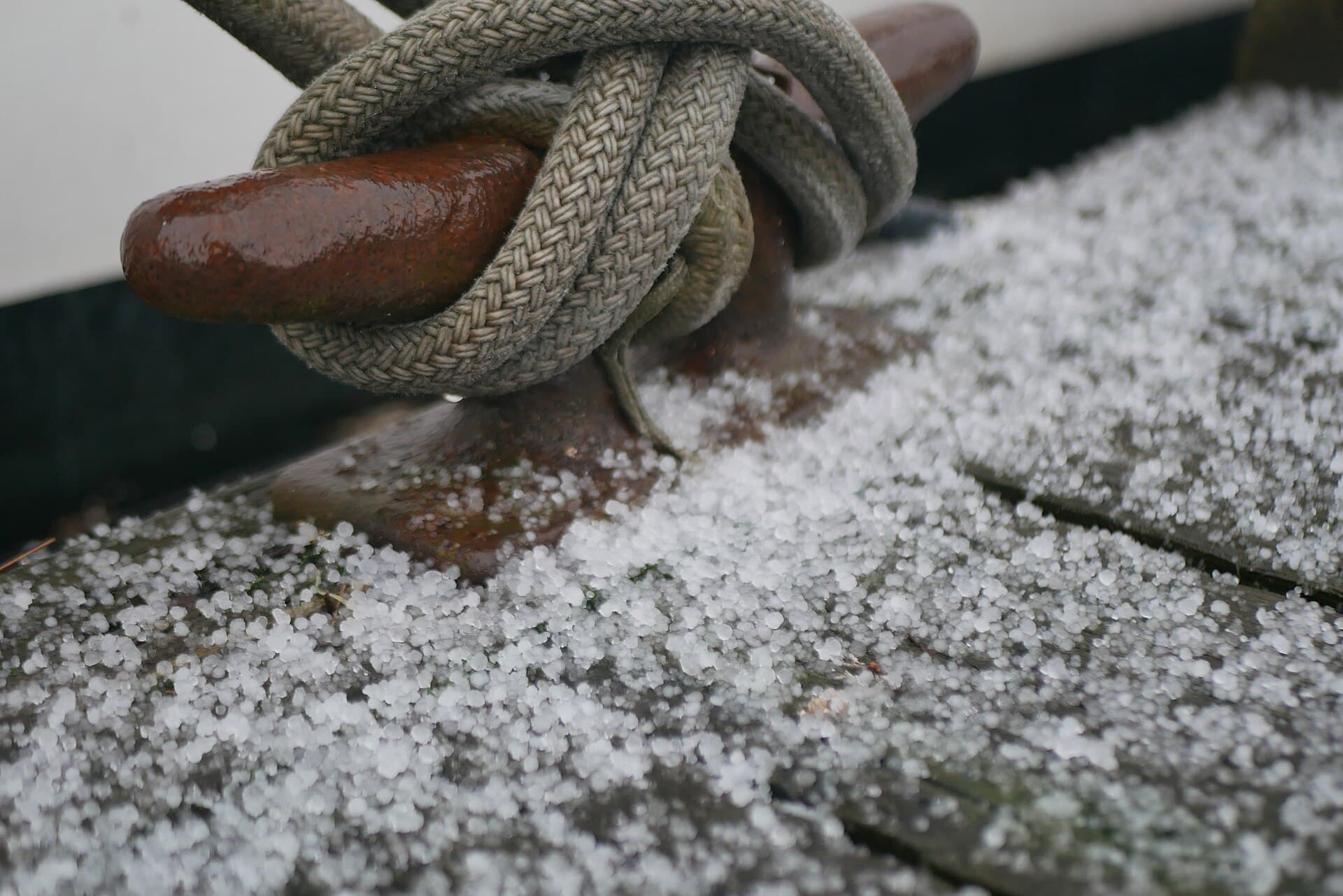
Fresh hailstones after a storm. Photograph: WindBorneListener. CC0. Source: Wikimedia Commons. See the image credits page.
Hail in Brisbane is not rare enough to be folklore and not common enough to be ordinary. It arrives with the same afternoon architecture as the rest of the wet season — heat, moisture off the bay, a collapsing cell — and then it adds stones. The stones do not care whether the roof is a 1970s concrete tile in Sunnybank, a terracotta hip in Ascot, or a Colorbond ranch in Springfield. They care about speed, size, and the angle of the wind that carries them.
The useful work begins the next morning. Not the night of, when everyone is tired and the radar is still lighting up the Gold Coast hinterland. The morning after is when you can see the lawn, the gutter, the cars, and the particular way a roof confesses. It is also when people make the two mistakes that cost the most: they clean up before they photograph, and they let someone sell them a coating before the roof has any right to be coated.
This is a companion to the wider account of how subtropical storms punish Brisbane roofs. Here the subject is narrower: hail on tile and metal, the evidence insurers actually use, the honest place of a tarp, and why a respray the next week is usually the wrong kind of urgency.
What hail does to tiles
Concrete tiles in the Brisbane stock are, by now, a middle-aged population. Many were laid in the decades when Monier-style profiles covered new estates from Aspley to Calamvale. The face has been UV-burnt. The slurry, if it ever had a factory finish left, is thin. Hail does not need to be spectacular to mark that surface.
A direct strike can crack a tile through. More often it bruises. The bruise is a white or pale crescent where the face has been crushed. Water will sit in that wound. The next wet season will widen it. Lichen will treat it as real estate. A later restorer will call the whole pitch “weathered” and propose a membrane, which may be reasonable, or may be a way of hiding a pattern of impact damage that an insurer should have been shown as discrete hits.
Terracotta behaves differently. It is harder and more brittle. A stone that bruises concrete may leave terracotta intact, or it may find an old firing line and split the tile along a curve that looks almost deliberate. On a heritage roof in Clayfield or Hamilton, that split is not only a leak risk. It is a matching problem. You will not walk into a warehouse and find the same tile in the same colour with the same decades of dirt in the pores. Restoration language starts to fail here. Replacement of the unit, or of the roof, becomes the adult conversation.
Look also at the ridges and the hips. Caps take hail on their crown. Pointing takes it as a series of small hammers. If the mortar was already tired — and in this climate it usually is — hail is the event that turns hairline cracks into open joints. The leak that appears two storms later will be blamed on “the pointing”, which is true in the way that blaming a fence post for the termites is true.
Sarking and insulation tell the rest. Hail that cracks a tile does not always wet the plaster on the first night. Water can travel. The morning after, a torch in the ceiling space of a high-set in Sherwood or a low-set in Carina may show dark spots on foil that were not there in spring. Those spots are evidence. They are also a reason not to walk around up there punching holes in plaster with your heels.
What hail does to metal
Metal roofs look, to the untrained eye, as if they have got off lightly. They often have not. Colorbond and older galvanised corrugated iron dent. The dent may not leak. It is still a change in the profile, a place where coating has been stretched or broken, and a place where water and dirt will sit instead of running.
On a Queenslander in New Farm or a 1990s steel roof in North Lakes, the argument that follows is almost always the same. The owner sees dimples in the late-afternoon light. The insurer sees a roof that is not letting water in. The restorer sees a surface they would like to coat. All three can be looking at the same sheet and meaning different words by “damage”.
Cosmetic denting on steel is still damage. Whether it is claimable depends on the policy, the assessor, and the photographs. Whether it should be coated depends on the depth of the bruise, the age of the sheet, the condition of the cut edges, and whether the fasteners and flashings failed as well. Coating a field of dents does not un-dent them. It can seal broken coating and slow rust. It can also lock in a profile that will never again shed water quite the way it was rolled to.
Edges and penetrations fail first. Hail likes the things that stand up: solar frames, vents, ridge flashings, the lip of a gutter. A stone that hits a solar clamp can loosen a hole that was only ever sealed with a generic rubber that has already cooked in the UV. The leak will not be in the middle of the sheet. It will be at the thing that was added later, which is how a lot of “the roof is fine, the solar guys did this” arguments get started, some of them fair.
Wind travels with the hail. The cell that drops stones on Redcliffe or Wynnum is also the cell that lifts. A dented sheet with two missing screws is a different job from a dented sheet that is still fast. The morning after, count fasteners with your eyes from the ground if you can. Look for the bright metal of a screw that has backed out, or the dark slot of one that has gone.
Photograph before you sweep
Insurers are not moved by the story of the night. They are moved by a sequence they can understand: weather event, contemporaneous damage, no intervening renovation. The morning after is when that sequence is either captured or destroyed.
Photograph the yard with the hail still on it if any remains, or with the melt-pattern in the mulch if it does not. Photograph the cars, the plastic outdoor furniture, the dents in the letterbox, the shredded leaves. These are not sentimental. They establish that stones of a certain energy fell on this block, not merely that a storm was in the news for the suburb.
Then photograph the roof from every safe angle. Phone cameras are adequate if you use them like a surveyor rather than a tourist. Overlap the frames. Get the ridge lines. Get the valleys. Get the solar array. Get the downpipes and the splash marks on the fascia. If a neighbour’s tree has contributed debris, photograph the debris where it lies, not in the bin.
Inside, photograph every ceiling mark, even the ones you “always had”. Date-stamp is automatic on most phones; keep the originals. Do not edit. Do not apply a dramatic filter because it looked more like disaster. An assessor has seen those.
Write a short note the same morning: when the cell hit, which direction the wind seemed to come from, whether you heard tiles crack, whether the solar inverter faulted, whether the ceiling leaked during the rain or only later. This note is for you. Memory after a claim is a poorer instrument than you think.
The longer paper trail — like-for-like, betterment, cash settlements — lives in the insurance, storm claims and restoration essay. None of that writing works if the morning after was spent with a broom and no camera.
Tarps, and the difference between shelter and theatre
A tarp is a temporary roof. It is not a restoration, not a claim strategy, and not a reason to stop documenting. Used well, it keeps the next afternoon’s shower out of the plaster while you wait for a licensed repairer. Used badly, it becomes a sail, a pond, or a way of hiding the evidence.
If tiles are missing or a sheet has lifted, a tarp that is actually tied through to something solid — not draped and hoped — can be the right ugly thing. The lines should not cut into gutters or saw at barge boards. The water has to have a way off. A tarp that holds a bath over the hip will deliver that bath into the house when someone adjusts a corner.
Many householders should not be the ones installing it. A wet tiled roof with moss on the southern pitch in Indooroopilly is a skating rink with a view of the river. Paying a licensed emergency crew for a few hours is not an extravagance. It is how you avoid a second, medical, claim.
Plastic in the ceiling can protect furniture. It does not fix the path. If you put a tub under a drip, empty it as if it were a job. A full tub on a plaster ceiling is a new hole with extra steps.
Do not let a tarp become permanent because the quote argument has stalled. UV in this climate eats poly tarps. What was emergency cover in March can be shredded lace by August. At that point you have a roof that is still open and a file that looks neglected.
Do not rush a respray
This is the sentence that loses the journal friends in the trade, and it is still the right sentence. Do not coat a hail-hit roof the following week because someone on the verandah said the colour would “seal the damage” and the insurer would like it.
Coatings need a dry substrate, sound pointing, sound valleys, and a weather window. Hail often arrives in the same months when those windows are short. A membrane over wet tile, over fractured pointing, or over steel that has not been assessed for puncture is not restoration. It is paint on a wound. The first serious cell will find the wound again. Some of the reasons restoration is the wrong job at all — crushed tiles, rusted structure, a roof at the end of its life — are gathered in when restoration is the wrong job. Hail makes that essay urgent rather than theoretical.
There is also the insurance problem. If you coat before the assessor has seen the discrete impacts, you have made the impacts harder to see. A restorer who offers to “sort the claim and the coating together” may be competent and may be blurring two duties. You are allowed to separate them. Storm making-safe first. Assessment second. Scope third. Restoration, if it is still the right job, when the roof is dry and the scope is written.
A morning-after order of operations
The following is not a legal process. It is the order that keeps the largest number of options open.
- Make the house safe: power if the solar or the wet ceiling requires it, a bucket where the drip is, sleep somewhere dry if you must.
- Photograph outside and in before you tidy.
- Note the time, wind and what you heard.
- Temporary cover only where the envelope is actually open.
- Call the insurer when you have enough photographs to describe a real event, not a mood.
- Get a licensed inspection that separates making-safe from restoration from replacement.
- Do not sign a coating contract on the same visit as the tarp.
Hail is a short event with a long paperwork life. The stones melt. The dents do not.
The cracked tile will still be cracked in winter, when the tourist storms have gone and the dew sits on the southern pitch until mid-morning. If you treat the morning after as evidence and shelter, rather than as a sales appointment, the later decisions have something to stand on.
Brisbane will do this again. The bay will feed another cell. A suburb you did not think of as “hail country” — Paddington, say, or a pocket of Wynnum — will find stones in the geraniums. The roofs that come through are the ones whose owners treated the morning as a record, not a reset. Keep the photographs. Keep the tarp honest. Keep the spray gun in the van until the roof is ready to be a roof again.
Questions from the verandah
- Do I need golf-ball hail before a concrete tile roof is considered damaged?
- No. Smaller stones at high speed will bruise, pit and crack tiles, especially older concrete with a weathered face. Damage is about impact energy and the condition of the tile, not a folk measurement against sporting goods.
- Should I put a tarp on the roof myself?
- Only if you can do it without walking a wet, broken surface and only if the tarp can be secured without creating a sail. Many householders are better served by a licensed emergency repair. An unsecured tarp that lifts in the next westerly is a second claim waiting to happen.
- Why do insurers and restorers argue about hail on metal roofs?
- Because dents that do not leak are still damage, and because coating over bruised steel is not the same as replacing it. Like-for-like, betterment and cosmetic damage are the words that fight. Photographs from the morning after are what those words stand on.