Journal home / All articles / Licences and the trade
Asbestos, older tiles and hidden hazards
Most Brisbane roof tiles are not asbestos. The sheets, linings, old backing and dust around them sometimes are. The competent response is neither panic nor a grinder.
Lila Nguyen · 18 April 2025 · Updated 27 June 2026
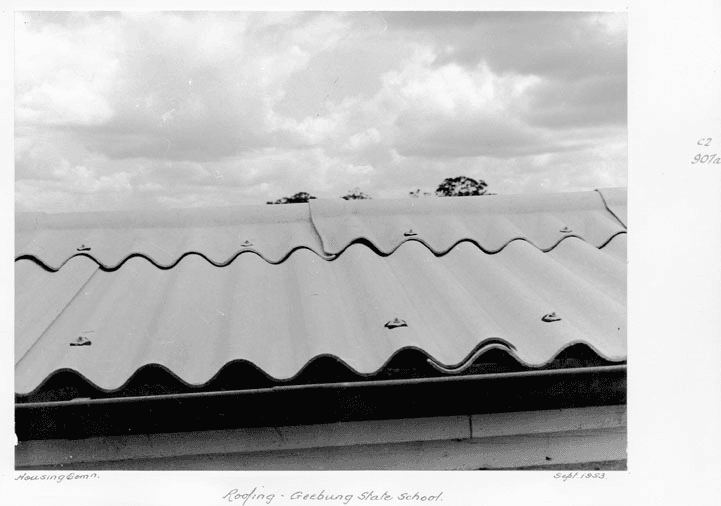
Public-domain Queensland State Archives photograph of school roofing at Geebung. Photograph: Queensland State Archives. Public domain. Source: Wikimedia Commons. See the image credits page.
There is a way of talking about asbestos in older Brisbane houses that turns every weatherboard into a crime scene. There is another way that treats the word as a nuisance raised by busybodies. Both are useless on a roof. The useful way is slower. It asks what the roof is made of, what is attached to it, what the proposed method will disturb, and whether anyone has actually identified the suspect material or merely gestured at the decade the house was built.
Most of the terracotta and concrete tiles sitting on Queenslanders and 1970s veneers are not asbestos-containing products. They are tiles. They can still be brittle, mossy, cracked and wrongly restored. That is a different problem, and it is covered elsewhere as a materials question in terracotta tiles on Queenslanders and interwar homes. Asbestos, when it appears in a restoration, is usually in the company the tiles keep: fibre-cement sheets on eaves and gable ends, some old backing and underlay, certain sealants and flashings, and the dust of earlier, less careful jobs.
Queensland built enthusiastically with asbestos-cement products through the middle of the twentieth century. Super Six and similar corrugated sheets went on sheds, carports and some secondary roofs. Flat fibre-cement lined eaves, soffits, bathroom ceilings and gable infills. The material was cheap, termite-indifferent, and everywhere. It was also not labelled for the people who would, fifty years later, want to grind a ridge or aim a pressure lance along a fascia. Houses in Windsor, Annerley, Moorooka and the older bayside streets are full of these quiet assemblies. So are school and civic buildings from the same decades. The 1953 Geebung roofing photograph on this page is a reminder of that building culture: mixed materials, practical, undocumented by modern product data sheets.
A restoration that only looks down at the tiles, and never along the eaves, is only inspecting half the workplace.
What is actually on the roof
Start with the covering. Concrete tiles, terracotta tiles, corrugated galvanised iron, and later Colorbond are the ordinary Brisbane palette. Slate appears, rarely, on more formal interwar houses. None of those coverings, in their usual manufactured form, are the asbestos story. The story starts at the edges.
Look at the eaves lining from the ground, then from a ladder if the material is unclear. Painted fibre-cement is common. It can look like a modern sheet. It can also be original. Look at the gable infills, the verandah ceiling, the lining over the side gate, the old laundry lean-to, the carport that was “always there”. Look at corrugated secondary roofs that are not the main house. Look at the backing behind decorative barge boards. Look at any sheet that will be stood on, screwed through, or washed at close range.
Old pointing and bedding compounds are a greyer area. Most modern flexible pointing is not an asbestos product. Historic cement-rich bedding is usually just cement and sand. Some older sealants, mastics and gasket materials around flues and flashings deserve more caution. So do some bituminous felts and underlays. The point is not to recite a horror list. The point is that “the tiles are terracotta, so we’re fine” is not an identification.
If the house was built or substantially altered before the 1990s — and most of inner Brisbane was — you should expect some asbestos-containing material to exist somewhere in the envelope. That is not the same as expecting it in the tile that will be coated. It is a reason to plan the inspection as an envelope inspection, not a colour inspection.
Dust, grinding and the methods that turn a sheet into a problem
Asbestos-containing material that is intact, sealed and left alone is often the least dramatic part of an old house. The danger that restoration introduces is mechanical. Grinding a ridge. Cutting a sheet to fit a new exhaust. High-pressure water aimed at a friable edge. Dry sweeping dust in a gutter. Dropping broken eaves lining into a trailer and then driving across town with the tailgate open. These are the moments when a stable product becomes respirable fibres.
A competent crew treats those moments as stop points. If they do not know what the sheet is, they do not grind it to “clean up the edge”. If the eaves lining is suspect, they do not use it as a platform, and they do not wash it at the same pressure they use on concrete tiles. If a previous restorer has left a crust of unknown coating and crumbled pointing in the gutter, they do not blow it into the garden with a leaf blower.
Pressure cleaning tile roofs without breaking them is written as a tiles-and-water essay. Read it with this page in mind. The lance does not know the difference between a concrete tile and a fibre-cement soffit. The operator has to. The old contractor sites in Brisbane often sold driveway high-pressure cleaning as a companion service. That work has its own sense: oil stains, mould on paths, a house that looks finished when the roof is done. It becomes reckless when the same lance is walked along an untested eaves lining because the crew is already in their water-blasting rhythm.
Harnesses and working-at-heights controls do not solve fibre. They stop a person falling off a two-storey Queenslander. They do nothing for the dust in the air if someone decides to angle-grind a suspect barge. The two hazards stack. A person on a brittle sheet, unanchored, grinding an unknown material, is a short story with a bad ending. Ask how the crew will work the edges, not only how they will coat the field.
When to stop and test
Testing is not theatre, and it is not an accusation. It is how you stop guessing. A licensed asbestos assessor can sample a sheet, a lining, a crumbled compound, and tell you what you have. The cost of that sample is small beside the cost of a contamination incident, a delayed job, or a crew that discovers the problem halfway through a grind.
Stop and test when any of the following are true.
- The eaves, gable or verandah lining is a painted sheet of unknown age, and the method will cut, grind, break or high-pressure wash it.
- There is damaged, crumbly sheet material already sitting in gutters or garden beds from a previous amateur repair.
- A flue, air-conditioner or solar penetration will be enlarged through an old lining or an old mastic.
- The contractor proposes to “take the old backing off” without naming the backing.
- You are in a pre-1990 house and the quote is silent about asbestos. Silence is not a clearance.
Do not stop the entire restoration because the house is old. That is the alarmist error. Do not tell the crew to “just get on with it” because you do not want a delay before the wet season. That is the reckless error. The middle path is identification, then a method that matches the result.
If the sample is negative, proceed, and keep the report with the quote. If it is positive, the work on that material becomes licensed asbestos work or a redesigned method that avoids disturbing it. Sometimes the honest redesign is to leave the eaves lining in place, coat only the tiles, and deal with the lining as a separate, properly controlled job. Sometimes the honest conclusion is that the roof is the wrong candidate for restoration at all — not because of asbestos in the tiles, but because the envelope is so compromised that a membrane would be cosmetics over a demolition. That argument belongs with when restoration is the wrong job.
Unknown material plus a grinder is not a work method. It is a wish.
Owner-operators, canvassers and the sentence you should not accept
Commission canvassers are not trained as asbestos assessors. They are trained to keep the conversation on colour, price and a discount that expires at dusk. If asbestos comes up, the stock reassurance is that they “deal with this all the time” or that “old Brisbane houses are all like that”. Neither sentence is an identification. Owner-operators who still climb tend to be blunter. They will point at a soffit and say they will not touch it until it is sampled. That bluntness is a professional courtesy, not a sales tactic.
QBCC licensing — historically the QBSA card that older quotes still mention — does not by itself make a person an asbestos professional. Roof tiling, painting and decorating, and roof plumbing are classes of building work. Asbestos removal and assessment are their own regulated activities. A current restoration licence is necessary. It is not sufficient. Ask who will identify suspect material, and what they will do if they find it after the job has started. A crew that has no answer will improvise, and improvisation with fibres is how households end up with a plastic enclosure on the front lawn and a story they did not budget for.
Working at heights intersects here in a practical way. Temporary rails and scaffolding at the eaves make it possible to inspect linings properly instead of leaning out from a ladder with a phone camera. A harness on the main pitch does not help you see the soffit. Access gear that is priced into the job is also inspection gear.
What to put in writing before anyone arrives
Ask for a line in the quote that names the known materials and the unknown ones. Ask what will happen if suspect material is found on day one. Ask whether the pressure-cleaning scope includes eaves and driveways, and whether those surfaces have been looked at. Ask the crew not to grind, sand or recut any sheet they have not identified. Keep children and pets off the driveway when water and debris are coming down, asbestos or not; slurry from a mossy roof is already a mess worth controlling.
If you have an older report from a pre-purchase inspection, read the asbestos section before you invite a restorer. Those reports are uneven, but they sometimes already name the eaves lining. Do not assume a “low risk if left undisturbed” note is permission to high-pressure wash the same sheet.
Brisbane’s older roofs can be restored without turning the house into a fable about contamination. They cannot be restored by pretending the twentieth century did not happen. Look at the tiles for what they are. Look at the sheets for what they might be. Test what you will disturb. Then decide whether the job is still a restoration, or whether it has become something more specialised, more expensive, and more honest.
Questions from the verandah
- Do terracotta or concrete roof tiles contain asbestos?
- Generally no. The tiles themselves are fired clay or cementitious units. The hazard, when it exists, is usually in associated materials: fibre-cement eaves and gables, some old underlays and backing, certain flashings and putties, and dust from previous work. Treat the assembly, not the tile in isolation.
- Should I assume a pre-1990 Brisbane roof is contaminated?
- Assume it may include asbestos-containing materials somewhere in the envelope, and test what will be disturbed. Do not assume the tiles are asbestos. Do not assume the soffits are safe because the tiles look fine.
- Can a restoration crew just “be careful” instead of testing?
- Care is not identification. If the material is unknown and the method will grind, cut, high-pressure blast or break it, stop and test. A licensed assessor is cheaper than a contamination incident.
- Is high-pressure cleaning a risk even when the tiles are safe?
- Yes, if the lance is turned onto fibre-cement eaves, old barge boards, or painted linings that can release fibres. The roof and the envelope are cleaned as a system only when someone has looked at what the water will hit.