Journal home / All articles / Licences and the trade
QBCC licensing and what it actually means
A Queensland Building and Construction Commission licence is not a personality endorsement. It is a legal threshold, a searchable record, and the first fact a Brisbane homeowner should check before anyone sets a ladder against the fascia.
Dean Harcourt · 24 February 2025 · Updated 6 July 2026
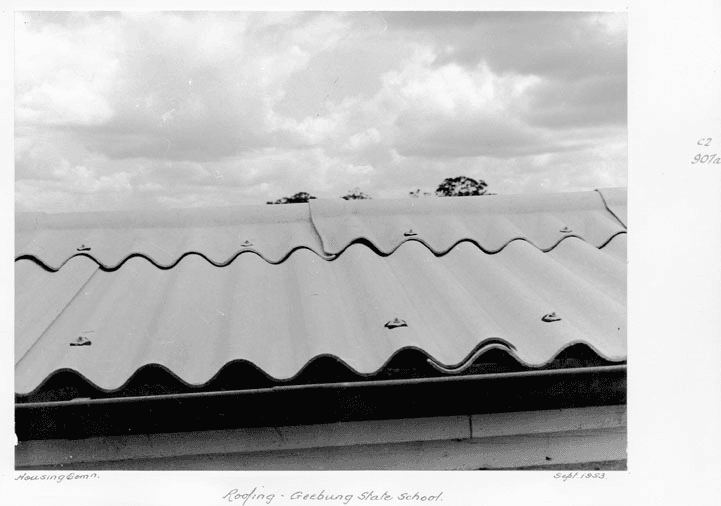
Public-domain Queensland State Archives photograph of school roofing at Geebung. Photograph: Queensland State Archives. Public domain. Source: Wikimedia Commons. See the image credits page.
A Brisbane roof is not a weekend hobby. It is a piece of licensed building work sitting eight metres above a timber floor, often on a pitch that punishes haste, and almost always above rooms a family still has to sleep in when the afternoon storm arrives. The Queensland Building and Construction Commission exists because that combination of height, water and money has a long local history of going wrong. A licence does not prove that a crew will treat terracotta with care. It does prove that the state has a record of the person who is offering to do the work, and that the work sits inside a legal class rather than a handshake.
Older householders still say QBSA out of habit. They are not wrong about the lineage. Until late 2013 the regulator was the Queensland Building Services Authority. The old contractor websites around Brisbane — including the family-owned restoration pages that once lived on this domain — printed QBSA numbers the way a baker prints a shop address. The change of name did not invent the idea of a licence. It inherited it. If you are reading a faded brochure from a kitchen drawer in Holland Park or a Wayback capture of a 2000s trade site, the number you see is an ancestor of the current register, not a separate system you can ignore.
What the licence actually means is narrower, and more useful, than the way it gets used on a verandah.
What a class is, and what it is not
QBCC licences are organised by class of work. Roof tiling, roof plumbing, painting and decorating, waterproofing, carpentry, and various contractor and nominee-supervisor arrangements are not interchangeable compliments. They are descriptions of the work a person is allowed to contract for. A restoration quote that bundles high-pressure cleaning, broken-tile replacement, ridge rebedding, flexible pointing, valley iron, and two coats of a heavy acrylic membrane is not a single magic trade. It is a stack of tasks that may require more than one class, or a contractor whose licence and subcontractors cover the stack.
That is why a homeowner who only asks “are you licensed?” receives a useless yes. The better question is which classes are held, whether they are current, and whether the person standing in the driveway is the licensed contractor or a canvasser who will on-sell the job to whoever answers the phone.
A painting and decorating licence may be enough for a membrane system on an already sound tile roof. It is not, on its own, a permission slip to rebuild a failed ridge, recut valleys, or treat the roof as a structural repair. Roof tiling is its own class because tiles that are cracked, slipped or poorly bedded are not a cosmetic problem. Roof plumbing exists because water has to leave the roof through gutters, valleys, flashings and downpipes, and because a coated tile that sheds water onto a rusted valley is still a leaking roof. Waterproofing is its own argument again, and it is the class most often stretched by people who want the word “membrane” to do more work than chemistry allows.
None of this is an invitation to become an amateur regulator on a Saturday morning. It is an invitation to read the quote as a list of licensed acts. If the specification in how to read a roof restoration quote talks about pointing and rebedding, the licence conversation should mention roof tiling. If it talks only about “spray-on restoration”, press for the classes underneath the slogan.
How to search the register without theatre
The public register is the least glamorous document in the job, and the most important. Search on the QBCC site. Prefer a licence number over a first name. Then search the trading name, because Brisbane crews have a habit of working under a van decal that is not the legal entity on the invoice. Read the status line. Current is not the same as previously licensed, suspended, or cancelled. Read the classes. Read any conditions. If there is a disciplinary history, read it in full rather than deciding that a single complaint from 2014 “probably doesn’t matter”.
Do this before you accept a site inspection, not after the pressure cleaner is on the driveway. A photograph of a plastic card is not a search. Cards are copied. Numbers are misread. A canvasser can flash a card that belongs to a contractor who is not the person who will climb the roof. The register is the record. The card is marketing.
If the person on the verandah objects to being searched, that is information. Licensed contractors who have kept their paperwork in order are not usually offended by a homeowner who takes a minute on a phone. They live inside the same system. The people who bristle are often the people who are selling someone else’s licence, or no licence at all.
A licence number recited from memory is a performance. A licence number that matches a current register entry, in the right class, for the legal name on the quote, is a fact.
Owner-builders sit in a different column. If you are doing work on your own home under an owner-builder permit, you still cannot pretend that an unlicensed crew becomes legal because you are standing on the lawn. The permit does not dissolve the contractor’s obligation. It also does not dissolve yours if you start directing unlicensed people onto a two-storey Queenslander with no working-at-heights plan.
Unlicensed work, and the risks that do not advertise themselves
Unlicensed contracting is an offence in Queensland. That sentence is printed so often it has lost its heat. Restore the heat. An unlicensed person who contracts for building work can be fined. The homeowner can be left without the statutory home warranty insurance that attaches to certain eligible residential work when a licensed contractor is used. Private insurers are not sentimental about leaks that follow unlicensed restoration. Neither are body corporates when a scheme building in New Farm or Kangaroo Point starts weeping into the unit below.
There is a second, quieter risk. Defective work by an unlicensed operator is hard to put right because there is no licence to complain against, no insurer sitting behind the contractor in the way the statutory scheme intends, and often no assets worth chasing. The crew that undercut everyone by thirty per cent is frequently a crew that cannot be found in February, when the first proper storm tests the pointing.
The old Brisbane trade had a blunt answer to this, and it was not a slogan. Owner-operators put their own names on the van. They expected you to look them up. They complained, with some justice, about commission canvassers who sold restorations they would never climb. The complaint still holds. A licence search is how you tell those two groups apart before anyone discusses colour charts.
What a licence does not buy you
A current licence is not a craft certificate. It does not tell you whether the crew will isolate asbestos in an old eaves lining before they grind a ridge. It does not tell you whether they will use harnesses and temporary anchors on a high-set terracotta roof in Paddington, or whether they will skip the gear to protect a cheap quote. Those questions belong in working at heights on Brisbane roofs and in the site inspection itself. The licence is the door. It is not the house.
It also does not tell you whether the membrane is a recognised system with batch numbers and a manufacturer pathway, or a generic acrylic bought in bulk and sprayed thick enough to hide the tile profile. It does not tell you whether the pointing is flexible and matched to subtropical movement, or a cement-rich mix that will hairline before the first wet season is out. Those are specification questions. The licence only tells you that the person offering the specification is allowed to offer it.
Home warranty insurance, where it applies, is another misunderstood comfort. It is not a product warranty. It is not a promise that the coating will last a decade. It is a statutory scheme that can assist homeowners in defined circumstances when a licensed contractor fails to complete work or does it defectively. Eligibility, thresholds and exclusions change, and they are not the same as a manufacturer’s document or a contractor’s written guarantee. Read the current QBCC material. Do not let a canvasser summarise it as “you’re covered, love”.
The practical sequence on a Brisbane job
Before you sign, do four unromantic things.
- Search the licence number and the legal name. Confirm the classes cover the work in the quote, not just the word restoration.
- Ask who will be on the roof: employees, subcontractors, or a labour-hire crew the contractor has never met. If subcontractors will tile or plumb, ask for their classes too.
- Ask for the written specification, the product names, and the working-at-heights method. A licence without a method is still a person on a brittle roof.
- Keep the search printout with the quote. If the job sours, you will want the record as it stood on the day you contracted, not as it stands after someone has “updated the paperwork”.
Then look at the person. Owner-operators who have been recoating roofs from Birkdale to Karalee for twenty years tend to talk about access, moss, broken tiles and the forecast. Canvassers talk about discounts that expire at dusk. The licence search is how you stop the second group from borrowing the credibility of the first.
If you want a fuller account of how to hold that conversation without being sold a colour, read choosing a contractor without a sales pitch. The licence is the first question on that list, not the last flourish on a signed form.
Brisbane’s older suburbs are full of roofs that have already been “restored” once by someone who was not licensed for the parts that later leaked. The membrane still looks handsome from the street. The valley iron does not. A register search takes less time than a kettle. Use it as if the roof were going to be yours in the next hailstorm, because it will be.
Questions from the verandah
- Is a QBCC licence the same thing the old QBSA card used to be?
- In substance, yes. The Queensland Building Services Authority became the Queensland Building and Construction Commission in 2013. The register, the offence of unlicensed contracting, and the idea of class-based licences carried over. The paperwork and the website changed. The duty to be licensed for the work you actually do did not.
- Does a painter’s licence cover a full tile-roof restoration?
- Not by itself. Membrane coating may sit inside painting and decorating, but rebedding ridges, replacing tiles, working valleys and flashings, and some waterproofing sit in other classes. Ask which classes are held, and match them to the specification, not to the flyer.
- How do I search the register properly?
- Use the public licence search on the QBCC website. Search by licence number first if you have it, then by name and trading name. Read the class list, the licence status, and any disciplinary or cancelled-licence notes. A card photographed on a phone is not a search.
- What happens if I hire an unlicensed crew?
- You may lose access to the statutory insurance scheme for eligible residential work, you may struggle with your own insurer after a leak, and you have little useful recourse if the work is defective. The contractor also commits an offence. Cheap is not a defence.