Journal home / All articles / Tile, tin and mixed roofs
Concrete tile roofs across Brisbane suburbs
From 1970s and 1980s estates to the last brick-veneer crescents, concrete tiles are the ordinary Brisbane roof. They are porous, they fade, they lose corners, and they can still be restored if you can match a profile the yard stopped making.
Tom Birtles · 9 June 2025 · Updated 20 August 2026
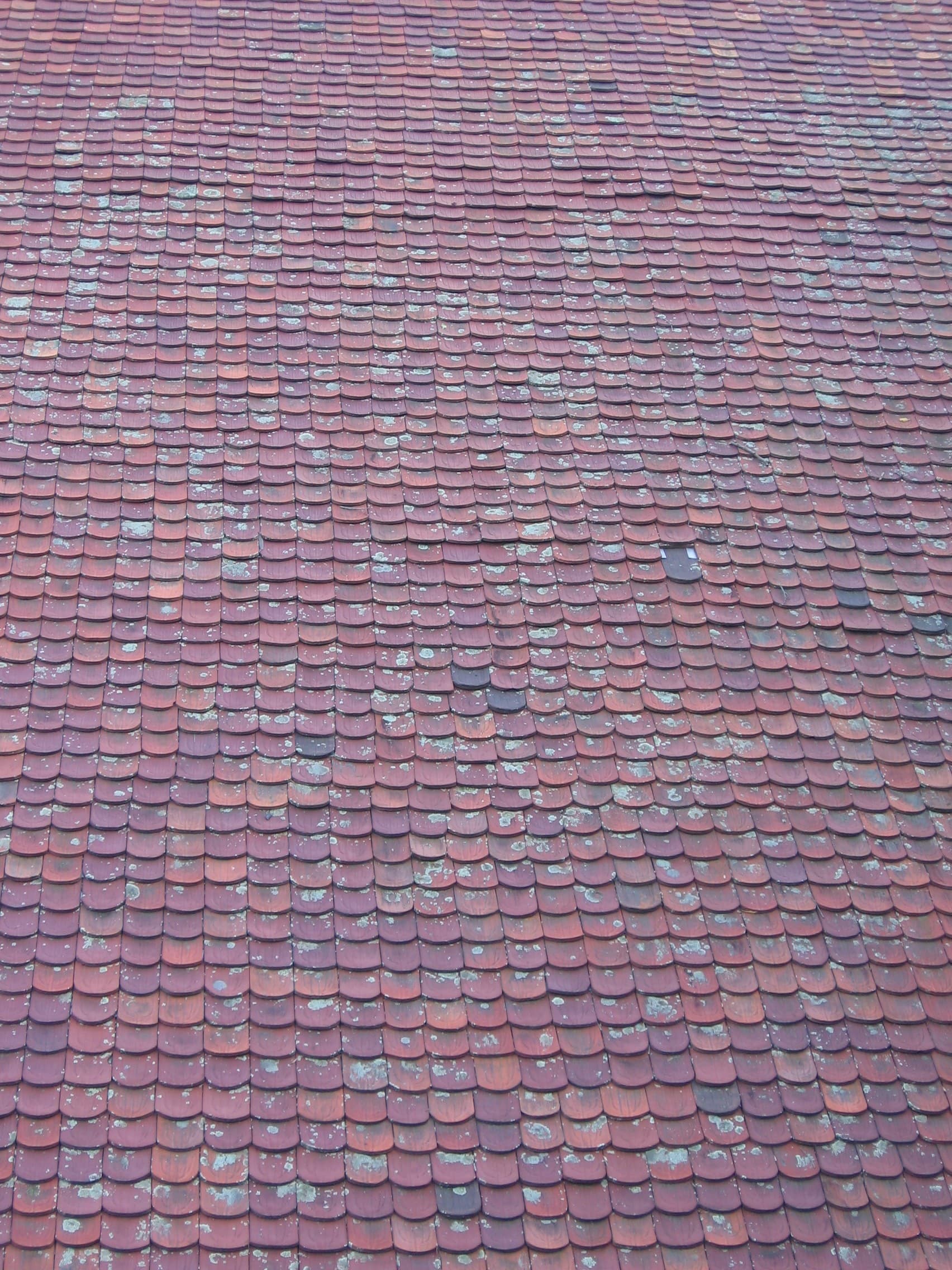
Close view of weathered concrete roof tiles. Photograph: PookieFugglestein. CC0. Source: Wikimedia Commons. See the image credits page.
Drive any of the crescents that were cut through bush and paddock between the early 1970s and the mid-1990s and you are looking at concrete tiles. Aspley, Sunnybank Hills, Regents Park, parts of Geebung, the low-set streets behind Cleveland, the brick veneers that filled in Gumdale and Birkdale: the same family of profiles, the same faded greys and tired browns, the same lichen on the south pitch. This is not the romantic Brisbane roof. It is the ordinary one. Most of the restoration trade in this city exists because of it.
Concrete tiles were cheap, fire-sensible, and fast to put on a truss roof that a project builder could repeat. They were also porous from the day they left the yard. A terracotta body, at its best, is a fired ceramic. A concrete tile is a cementitious thing that will drink weather for the rest of its life. That porosity is why they grow biology, why they fade, and why a membrane system — sealer and two coats — has a natural home on them that it does not always have on terracotta.
This is a map of that ordinary roof: how it fails, how it is matched, and why a suburb's age is often a better guide to the job than a colour chart.
The estate years, and what they left on the skyline
Brisbane's concrete-tile belt is a history of land release. The 1970s houses are often lower-pitched, simpler hips, darker original colours that have long since gone to bone. The 1980s piled on more hips, more valleys, a skylight, a darker brown that the sales office called Spanish. The early 1990s added the odd grey that was meant to look like slate and fooled nobody by 1998. None of this is mockery. It is how you guess, from the street in Karalee or Aspley, what profile you are about to hunt.
Project builders bought tiles by the truck. Whole streets share a mould. That is a gift when you need a match: the demolition of number 17 can save number 42. It is a problem when the mould was a short run, or when a later owner replaced a pitch with a near-enough profile after hail. Mixed profiles on a single roof are more common than brochures admit. Light, especially a low winter sun in Chelmer-adjacent streets that still have a few concrete roofs among the tin, will show every change of wave.
The roof space under these houses is usually truss, which means the battens are doing a defined job and the access is a hatch and a crawl. Insulation, if it exists, will hide the very battens you want to see. A restoration inspection that never enters the space is an inspection of the colour, not of the roof.
Porosity: the feature that became the defect
A new concrete tile is already full of pores. Weather opens them. Lichen colonises them. A hard wash fills them with water. A hot October day drives that water back out, sometimes through a film that was put on too soon. Understanding porosity is understanding most concrete-tile behaviour in this climate.
It is why a dry-looking roof in Greenslopes can still be a wet substrate at nine in the morning. It is why a sealer is not optional on these tiles if you are building a film. It is why a thin paint looks finished on handover and chalked by the second summer. The tile is not trying to be difficult. It is trying to be concrete in a subtropical sky.
Porosity also holds the last failed coating. If someone sprayed a thin acrylic in 2011 and it has gone to powder, the powder is in the pores. The wash has to lift it, or the new sealer will bind a chalk. This is one reason pressure cleaning on concrete is a different conversation from terracotta. Concrete will usually take more jet. It will also hide more leftover film.
Salt is not a Sydney-cliff problem here, but driving rain and pollution grit are enough. Tiles under a busy road in Geebung soil differently from tiles under a fig in a back street of Corinda. The wash should notice. The coating spread should notice. A specification that treats every concrete roof as the same square metre is a specification written in an office.
Colour fade, slurry and the grey underneath
Many of the colours people remember — terracotta-look, charcoal, a green that was briefly fashionable — were not through-body. They were slurries, oxides, a surface that UV could unpick. What you see now on a Sunnybank Hills street is often the cement colour with a memory of the oxide in the sheltered laps. Owners ask for “the original colour back.” The original colour was a surface. The body is grey.
You cannot wash a faded concrete tile back to showroom brown. A membrane does not restore the original. It installs a new surface.
That is a perfectly honest thing to want. It is not time travel. Cool-roof tints, lighter than the charcoal the street has decided is tasteful, will do more for the upstairs rooms than a dark recreation of 1987. The membrane essay covers film and windows. Here the point is expectation. You can clean the tile, repair it, and decide a colour for the next decade.
Fade is not even. North and west go first. A south pitch in Cleveland may still hold a hint of the old tint under the lichen. If you are matching a repair tile on an unrestored roof, you are matching a gradient, not a colour. On a roof about to be coated, match the profile and forget the tint. The film will do the unifying.
Broken corners, hail and the boot
Concrete tiles lose corners. They lose them to hail, to a branch, to a satellite dish installer, to the person who walked the roof in hard shoes to quote the coating. A missing corner is not always a leak — the lap may still shed — but it is a start. Water and biology find the broken edge. The next storm finds it faster.
Hail across Redcliffe and the bayside will leave a pattern: bruised faces, snapped horns, the occasional hole. The pattern is useful. It tells you whether you are in ones and twos or in a density that makes restoration a fiction. Ones and twos are a ute and a matching morning. A density is a conversation about strip and replace, at least on the exposed pitches.
Walking these roofs requires the same soft-soled humility as any tile roof, with one local note. A concrete tile that sounds hollow may be sitting on a batten that has pulled, or it may have already cracked through the body. Do not decide with a bounce. Decide with a look from below if you can, and with a willingness to replace the one you were wrong about.
Ridge caps on these estates are often the same family of concrete, and they fail as ridges fail everywhere: bed to powder, pointing to a painted crust. The estate roof is not exempt from rebedding because it is unfashionable. It is, if anything, more likely to have had a skip-the-ridge restoration already, because the house was priced as ordinary.
Matching discontinued profiles
This is the unglamorous craft. A profile is a wave, a headlap, a thickness, a particular way the water is supposed to run. Close enough is visible. A slightly flatter tile in a run of deeper ones is a shadow line you will see from the kitchen window for as long as you own the house.
Sources, in practice:
- The same street, and the neighbour who is demolishing a carport.
- Yards that still hold 1970s and 1980s stock, if you know what to ask for by shape rather than by a brand the owner has forgotten.
- Salvage from roofs that are coming off for metal, which is a common second life for a tired concrete house.
- New tiles in a related profile, used in a place the eye does not linger — a low rear pitch — while the street face keeps the old mould.
Ridge caps and accessories are harder than field tiles. Hip starters, three-way apexes, a decorative end that a 1984 display home insisted on: these are the pieces that turn a simple replacement into a hunt. Do not let a quote assume they are in the trailer. Ask.
A membrane will not hide a wrong profile. It will, at best, make two wrongs the same colour. Light still finds the edge.
Suburb by suburb, without a sales map
Aspley and Geebung still show long runs of the same brown-grey concrete, low-set, solar arriving late, gutters original and tired. The restoration here is often the textbook sequence, if the battens have stayed dry.
Sunnybank Hills and Regents Park add more complicated hips and the odd two-storey that was a statement in 1989. Valleys multiply. So do the chances of a rusty trough. Access is easier than a high-set Queenslander and harder than the brochure's “two to three days” if the plan is a knot.
Birkdale, Gumdale and Cleveland sit in a weather that comes off the bay with a little more salt and a lot more driving rain. Lichen is not a scandal. It is a forecast. Washes here need the gutter conversation, and coatings need the wind conversation.
Karalee and the western estates can be hotter and, on some streets, newer in their concrete, which means the fade is less advanced and the profile easier to match. It also means more roofs that look “too good to restore” while the pointing is already a hairline.
Inner-south pockets — Greenslopes among them — mix concrete with older terracotta and tin on the same block. The concrete house is sometimes the renovated one, sometimes the one that has not been touched since the tiles were laid. Do not read the suburb as a single material.
None of these notes are a quote. They are a way of saying that “concrete tile in Brisbane” is not one roof. It is a thirty-year production with local weather and local additions.
What restoration looks like when it is the right job
On a sound concrete roof the old sequence still fits. Replace the broken. Cut the rusty valleys. Rebed the ridges. Wash with a jet the tile can take, and give the pores time to dry. Point. Seal. Two membrane coats in a window the sheet would recognise. The porosity that made the tile fade is the same porosity that will take a sealer properly.
The wrong job, on these estates, is usually a colour over a valley that has already gone, or a skip-the-ridge spray because the house was not worth the mortar in someone's maths. Ordinary is not the same as disposable. A low-set in Aspley is allowed a specification.
Owners should ask for the profile name or a photograph of the match, the valley metal as a line item, the ridge as a lift rather than a paint, and the coating as a system. They should walk the ceiling after rain, once, before they sign, and again after the wash if the crew will allow it. Concrete dust and old leaks tell the truth more politely than a salesperson.
The ordinary roof, taken seriously
There is a snobbery in this city that reserves attention for terracotta on a Queenslander and treats concrete as the thing you cover until you can afford Colorbond. Sometimes metal is the right second life. Sometimes the concrete has another decade in it if someone is willing to treat it as a material rather than as a background.
The estates are not going away. They are where a large part of Brisbane actually lives, under tiles that were never meant to be pretty in old age and can still be made weather-tight and decent. A journal that only wrote about heritage clay would be writing about someone else's house. This one will keep coming back to the grey roofs of Aspley and Sunnybank Hills, because that is where the trade, and the weather, spend most of their time.
Questions from the verandah
- Why do Brisbane concrete tiles fade so badly?
- The original colour was often a thin slurry or oxide in a porous body. UV, rain and lichen strip and stain that surface until the tile is the grey of the cement itself.
- Can you still match old concrete profiles?
- Sometimes. Common 1970s and 1980s shapes remain in yards and on demolition trucks. Obscure profiles and old ridge caps can take a hunt, and a close-enough tile will always show in raking light.
- Are concrete tiles a good candidate for a membrane?
- Often, if the timber is sound and the broken ones can be replaced. Porous concrete is the surface those acrylic systems were designed around, provided the wash and the coats are done as a system.
- How long do unrestored concrete tiles last in SEQ?
- The body can sit for decades. The surface, the corners and the pointing usually fail first. Life is less a date than a density of defects and a roof space you are willing to inspect.